

How Low Is Too Low? What a Sportswear Factory Wishes Startups Knew About MOQ
Early in building her brand, Hyla Nayeri — co-founder of the activewear brand 437 — wired a $30,000 deposit to a manufacturer. She had visited their facility in person. Confirmed the samples. Everything checked out. Then the response times stretched from hours to days, then to silence. A friend went to check the address. Empty building. Papers flying on the floor. The factory had gone bankrupt overnight. No product. No refund. The deposit was gone.
She told this story on Shopify Masters in 2026, and the room went quiet (Shopify Masters, 2026). Every founder listening knew: that could have been me.
If you are launching an activewear brand, the acronym that keeps you up at night is probably MOQ — Minimum Order Quantity. It feels like a wall between you and getting started. So when you find a factory offering 50 pieces per style, it feels like a door opening. But here is what most sourcing guides will not tell you: that door sometimes opens onto a cliff.
We are writing this from the other side of the table. ZIYANG is an activewear OEM manufacturer. We have been on the factory floor since 2013. And there are things we wish every startup founder understood before sending that first inquiry.

Why Do Factories Set MOQs in the First Place?
If you have ever wondered why a factory cannot just run 30 pieces of your legging design, the answer is not “they do not want your business.” It is that three separate supply chains have to converge before a single stitch is sewn — and each one has its own minimum.
The fabric mill sets the first floor. A polyester-spandex blend needs to be dyed to your exact shade. Industrial dyeing machines require a minimum fill volume to run — well beyond what a small-batch order consumes. If your 50-piece order uses a fraction of that capacity, the mill still has to run the full bath. Someone pays for the unused portion. That someone is you, in the form of a dye lot surcharge — anywhere from a few hundred to over a thousand dollars per fabric, per color.
The trim suppliers set the second floor. Zippers, elastic bands, care labels, hang tags — every component comes from a different vendor, and each has its own MOQ. You might need 300 care labels, but the label printer’s minimum is 1,000. You pay for all 1,000, or you pay a surcharge. Multiply this by every trim on your garment.
The production line sets the third floor. A knitting machine like a Santoni seamless unit takes time to reprogram between styles. Cutting tables need to be laid out. Sewing lines need to be balanced. Setting up a line for 50 units costs nearly the same labor as setting it up for 300 — but the setup cost per unit is six times higher on the smaller run.
None of this is the factory being difficult. It is physics and economics stacked on top of each other.
What Happens When an MOQ Is Too Good to Be True?
If a factory quotes you 50 or 100 pieces per style with a straight face, ask yourself one question: why are they available?
Reputable activewear factories are usually busy. Their production calendars are booked months ahead by brands placing repeat orders. A factory with enough idle capacity to run a 50-piece order at a competitive price is not being generous. They are either inexperienced, financially unstable, or planning to make their margin somewhere you cannot see.
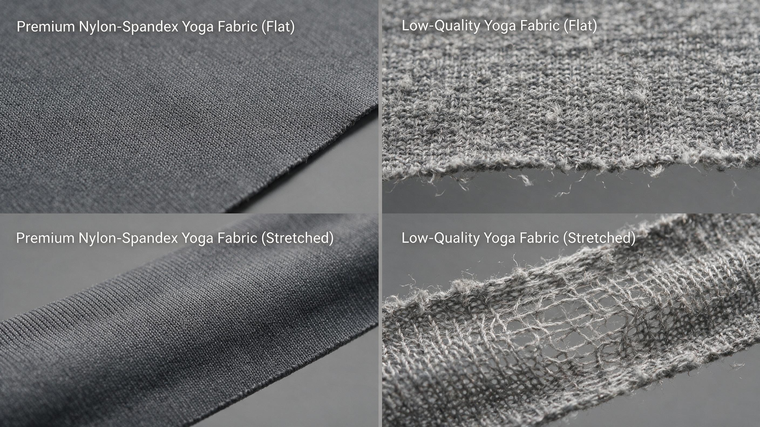
Here is where it gets ugly. We have picked up clients who came to us after their previous supplier pulled a bait-and-switch: the samples arrived looking flawless — right fabric weight, clean stitching, solid colors. The bulk order arrived six weeks later and looked like a different product. Thinner fabric. Uneven seams. Colors half a shade off. The factory had used quality materials for the sample to win the order, then sourced leftover stock for bulk production. This pattern is common enough that we see it several times a year from brands switching suppliers.
Ultra-low MOQs often carry another hidden cost: no technical support. Small factories accepting tiny orders rarely offer in-house pattern grading, fabric testing, or design feedback. You are left managing development on your own, which means you are paying in your own time and mistakes.
What Is a Realistic MOQ — and What Are You Actually Paying For?
Let us put real numbers on the table. Here is what different MOQ tiers actually mean in activewear manufacturing:
| Production Route | Typical MOQ | What You’re Actually Getting | Best For |
|---|---|---|---|
| Stock fabrics, existing patterns | 30–100 pcs | Off-the-shelf materials, standard design, no custom development | Testing a brand concept |
| Custom fabric on stock base | 100–200 pcs | Your color on an existing fabric, basic customization | Validating a proven design |
| Full OEM with custom fabric | 600–800 pcs | Your fabric, your design, your trims, full development | Building a real brand |
| Sustainable/eco fabric line | ~1,000 pcs | GRS-certified materials, dedicated production batch | Brands with sustainability commitments |
The jump from stock fabrics to custom fabric is where most of the cost lives — and it is almost entirely driven by those dye lot and trim minimums we described above.
There is another dimension to this table that does not fit in four rows: what the higher tiers actually deliver in measurable terms. At the OEM tier, a well-run factory should be able to tell you its defect rate (ours is under 1%, using ISO 2859-1 AQL sampling), its on-time delivery record (ours is 98% OTIF), and how it achieves cost efficiency without cutting material corners (for us, lean production and smart scheduling bring costs roughly 12% below the industry average for comparable quality). We break down these systems in more detail in Is Your Supplier Holding Your Brand Back?. If a factory cannot give you these numbers, you are buying opacity along with your units.
A realistic “low MOQ” for quality activewear — where you get proper fabric, consistent sizing, and technical support — starts around 200 to 300 pieces per style. Below that, you are either paying surcharges that make your per-unit cost higher than a 500-piece run, or you are trading away quality in ways you will not see until the box arrives.
How Do You Start Small Without Getting Burned?
If 300 pieces per style is still more than you can commit to, there are ways to start smaller without walking into a trap. You just need to ask the right questions before you wire the deposit.
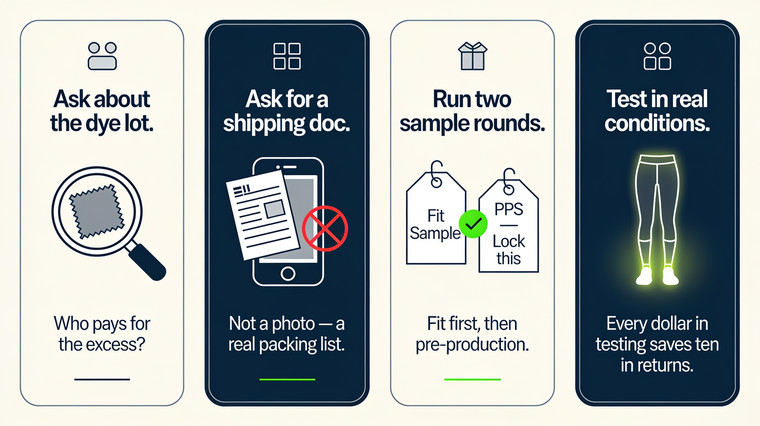
Ask about the dye lot. “What is the minimum dyed fabric length for this color, and who pays for the excess?” If the factory cannot answer this question in detail, they are not managing their own supply chain.
Ask to see a shipping document — not a photo. Photos of finished garments can be pulled from anywhere. A factory that has actually produced for real brands can show you a packing list, a bill of lading, or a shipment photo with dates and quantities. If they claim to make for major brands but cannot produce a single shipping record, walk away. Factories working with name brands are typically under NDAs that prevent them from advertising those relationships — so a factory that publicly boasts about making for Nike or Lululemon should raise questions.
Run at least two sample rounds before bulk. A fit sample first — focus on sizing, cut, and ergonomics. Then a pre-production sample (PPS) — this must use the exact fabric, colors, and trims that will go into bulk production. Sign off on the PPS in writing. Lock it as the production standard. If the factory pushes you straight from first sample to bulk order, that is a red flag.
Test the product in conditions your customer will actually use. For leggings: squat test under bright light. For sports bras: wear-test through a heated workout. Online returns in fashion ecommerce hit 19.3% across all categories in 2025, with clothing and accessories the most returned segment of all — and fit is consistently the top reason (NRF / Shopify Enterprise, 2026). Every dollar you spend on testing before bulk is ten dollars saved on returns and refunds.
When Is It Time to Move Up From Your First MOQ?
Starting small is smart. Staying small when your brand is ready to grow is a different kind of risk.
You know it is time to move up when three things happen at the same time:
First: your reorder velocity tells you something. If you are selling through your initial batch and reordering the same style, you have proven demand. At that point, the per-unit premium you are paying on small-batch production is eating into margins you could be keeping.
Second: your customers are asking for things you cannot deliver at your current MOQ. Custom colors. Matching sets. Sustainable materials. These requests mean your audience trusts your brand enough to want more from it — and fulfilling them requires moving into custom fabric territory.
Third: your current factory cannot explain where your fabric comes from. If your supplier dodges questions about mill sources, dye processes, or certification status, they are likely buying spot-market materials and you have no supply chain visibility. That works for testing. It does not work for building a brand.
The transition from small-batch to full OEM is not just about ordering more units. It is about moving from a transactional relationship — you pay, they sew — to a partnership where the factory invests in understanding your brand’s trajectory. That is when you get fabric development support, proactive quality feedback, and production priority. We wrote about what that kind of partnership looks like in practice — the specific systems, quality thresholds, and service commitments a factory should have in place — in Is Your Supplier Holding Your Brand Back?.
The 437 founder who lost her $30,000 deposit eventually rebuilt. She launched a new collection, found a reliable manufacturing partner, and scaled to eight figures. But as she told Shopify Masters in 2026, that early setback rippled through every decision that followed — from how they vetted suppliers to how they structured their team (Shopify Masters, 2026). In a market where competitors launch every week, lost time is the one cost you cannot recover.
Your first MOQ is not just a number. It is the first test of whether your manufacturing partner sees your brand as a transaction or a relationship. Choose accordingly.
Sources
- Shopify Masters. “How Getting Back to Basics Turned 437 Into an 8-Figure Brand.” June 2026. Interview with Hyla Nayeri, co-founder of 437. Link
- Shopify Enterprise / NRF. “Ecommerce Fashion Industry in 2026: Statistics, Trends and Strategies.” Citing NRF 2025 return rate data. Link
ZIYANG is an activewear OEM/ODM manufacturer founded in 2013. We work with brands across more than 70 countries, from first sample to scaled production. Our four-tier production model lets brands start where they are ready and grow from there. Learn more at activewearoem.com.
Post time: Jul-13-2026
