

What Tests Should Brands Request for Hot-Weather Activewear?
January 2026. Lululemon launched a new collection called "Get Low." Within days, online sales were temporarily paused after customer complaints that the leggings were see-through, revealing underwear and thigh tattoos through the fabric (BNN Bloomberg, 2026). Founder Chip Wilson later called it a "total operational failure," noting the line was "pulled back after three days" (BNN Bloomberg, 2026).
This was not Lululemon's first sheerness incident. It was the third in 13 years: the 2013 Luon recall, the 2024 Breezethrough pause, and now Get Low. Across the aisle, Gymshark's Vital Soft Leggings carry a warning on their own product page: "Just don't hit any super deep squats. The fabric may become sheer when pushed to the limit." Nearly half of the 101 reviews on the product page reported serious dissatisfaction, with transparency being the dominant complaint (Gymshark, 2025).
The common thread across all three cases: standard fabric testing did not catch the problem before customers did. What shows up in the lab may not reflect what happens in a hot yoga studio.
This is a sourcing problem hiding inside a product problem. For emerging brands, online store owners, and product managers placing summer production orders right now, it is worth understanding before the samples arrive.
Table of Contents
Why Do So Many Leggings Fail in Summer?
The short answer: because most of them were not tested for summer.
Standard fabric testing follows a predictable script. A swatch is stretched on a tensile tester at 21 degrees Celsius and 50% relative humidity. Opacity is checked against a light box. Abrasion resistance is measured on a Martindale machine under dry conditions. The swatch passes. Production begins.
What this script does not account for: a yoga student holding downward dog in a 38-degree room after 40 minutes of continuous sweating. Or a runner logging 10 kilometers on asphalt in direct sunlight, with salt crystals forming along the waistband seam. Or someone wearing the same pair of leggings through an eight-hour summer day: commute, workout, errands, repeat.
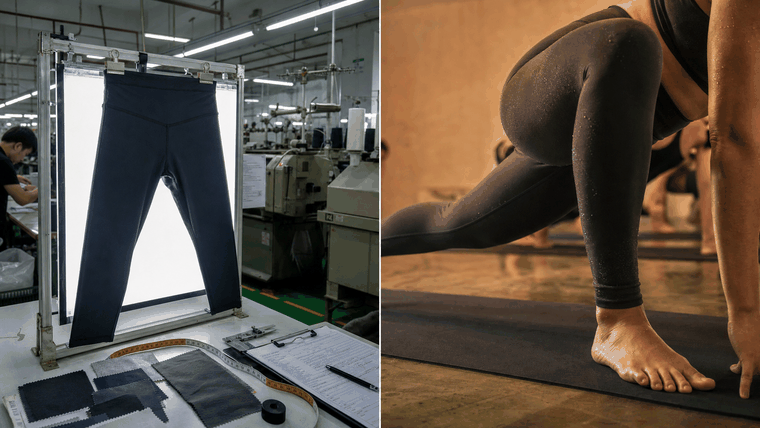
An academic study surveying 133 female college students about legging preferences identified see-through fabric as the most frequently encountered functional problem and the most frustrating one, ranking above holes, pilling, and body odor (Gale Academic OneFile, 2019). "Not see-through" was the second most desired feature after comfort.
When a customer discovers that a pair of leggings turns translucent in a squat, she does not usually file a complaint. She just does not buy from that brand again. The loss is silent. It does not show up in return data because the product itself is not defective by any standard the brand tested for. It simply was not tested for the right thing.
This is not a quality control issue. It is a sourcing specification issue.
The fix starts with one question: what temperature and humidity level do you expect your customer to be wearing this product in?
What Actually Happens to Activewear in the Heat?
Heat does not just make people sweat. It changes the physical behavior of fabric.
Nylon absorbs moisture. When nylon fibers take on water, their refractive index shifts. A fabric that looks completely opaque at 21 degrees and 50% humidity can become semi-transparent at 35 degrees and 60% humidity after 30 minutes of wear. This is not a defect in the yarn. It is a predictable physical response that standard lab conditions never trigger.
Elastic fibers degrade faster under combined heat and moisture. A waistband that snaps back perfectly after 20 dry stretch cycles may lose recovery after 20 cycles in a hot, wet state. The difference between "passes the spec" and "fails on the customer" is whether the test included temperature and moisture as variables.
Seam friction multiplies. A flat seam that feels invisible against dry skin turns into an abrasion point when both the fabric and the skin are wet. In hot yoga, where students hold forward folds and twists for extended periods, every seam point is a potential irritation source. In running, the repetitive motion of the inner thigh seam against wet fabric can produce chafing within 20 minutes.
Different hot-weather scenarios place different demands on fabric. A single product cannot optimize for all of them simultaneously. The brands that get this right are not the ones with the most advanced fabric technology. They are the ones that made a clear choice about which scenario their product serves.
| Scenario | Conditions | What the Body Goes Through | Biggest Fabric Risk | Test Most Often Skipped |
|---|---|---|---|---|
| Hot Yoga | 35 to 40 degrees C, 60% humidity | Continuous heat soak, sweat does not evaporate | Wet-state opacity drops sharply | Wet opacity test |
| Summer Outdoor Running | 30 to 38 degrees C, direct sun plus asphalt radiation | Salt crystal buildup, sustained repetitive friction | Seam abrasion under moisture, red marks | Wet-state Martindale abrasion |
| Hot Indoor Gym | 28 to 35 degrees C, equipment contact | Intermittent heavy sweating, metal surface friction | Panel seam tears, elastic bagging out | Elastic recovery after heat aging |
| All-Day Summer Wear | 25 to 35 degrees C, 8 to 12 hours | Low intensity but prolonged wear | Odor buildup, surface pilling | Antibacterial efficacy plus pill rating |
For OEM buyers sourcing hot yoga shorts or leggings, the Hot Yoga row in this table is the performance ceiling. A product that holds up in those conditions will almost certainly perform in the other three scenarios.
The cooling fabrics market reached $2.75 billion in 2025, with a projected 7.2% compound annual growth rate through 2031 (Deep Market Insights, 2025). Asia-Pacific is the fastest-growing region. This growth is not driven by brands suddenly caring more about fabric. It is driven by consumers spending more time exercising in hot conditions and becoming less tolerant of products that were not designed for those conditions.
Three Hidden Tests Most Brands Skip Until Customers Complain
When a product fails in hot conditions, the post-mortem usually lands on the same three tests that were never part of the original specification. None of them requires specialized equipment that a competent manufacturer does not already have. They simply need to be requested.
Wet-State Opacity: What You Cannot See at Room Temperature
The most common hot-weather failure has nothing to do with fabric weight. A 230 GSM nylon-spandex legging can be perfectly opaque when dry and significantly less so when saturated with sweat. The mechanism is optical: water fills the spaces between fibers, changing how light passes through the knit structure.
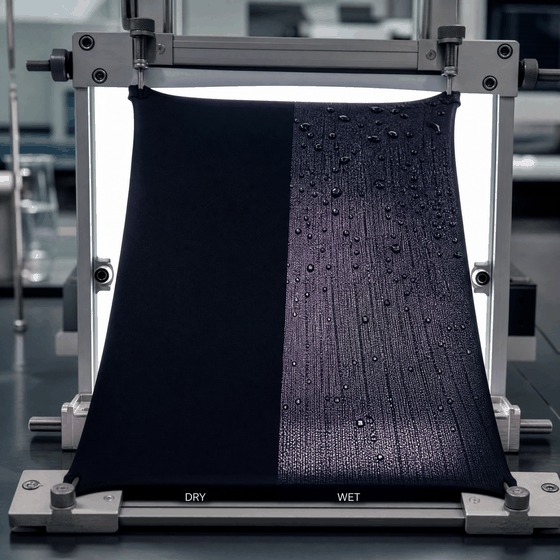
Lululemon's Get Low leggings were not unusually thin. What the incident highlights is a gap between standard dry-condition testing and how fabric actually performs when saturated with sweat. Wet-state opacity can be measured: light transmission through fabric at a standardized stretch percentage after the fabric has absorbed a specified amount of water. Requesting it during the sampling phase adds minimal time. Discovering the problem after a customer posts a photo costs a product line.
At ZIYANG, fabric testing includes color fastness to Grade 4 to 5 and light fastness to Grade 5 to 6. These numbers are public on our fabric page. When you ask a manufacturer for additional test data, whether they can produce it tells you something about their quality systems.
Seam Friction Under Moisture: Not the Same as Dry Abrasion
A seam that passes a standard Martindale abrasion test in dry conditions can produce visible skin irritation after 25 minutes in a hot yoga class. The difference is moisture acting as both a lubricant and a swelling agent. Wet fibers expand. Wet skin softens. The friction coefficient between seam and skin changes.
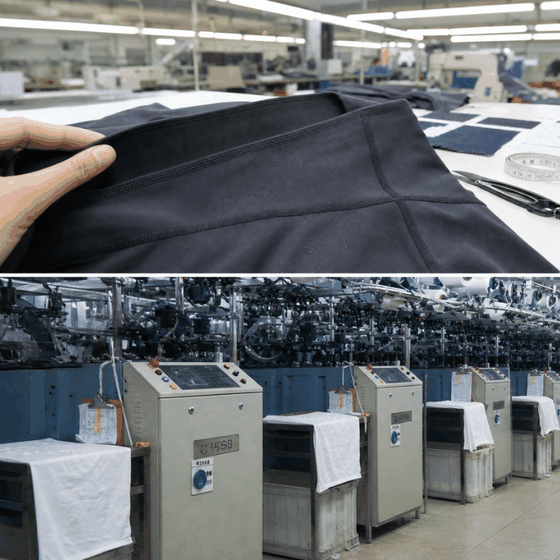
Seamless construction has a structural advantage here, and the reason is mechanical rather than marketing: a garment knit on a circular knitting machine emerges as a tube with no side seams. There is no seam line to absorb and hold sweat against the skin. For OEM hot yoga sports bras and high-sweat indoor training apparel, this is not a design preference. It is a functional difference.
For products that do require seams, the stitch type matters. A Flatlock 4-needle 6-thread construction keeps the seam profile flatter than an overlock. ZIYANG runs both seamless and cut-and-sew lines. The recommendation we give to brand clients is consistent: pick the scenario first, then pick the construction method. Seamless makes sense for heat-heavy environments where sweat and friction intersect. Cut-and-sew offers more flexibility when the design involves multiple fabric panels, reflective elements, or complex silhouette lines.
Antibacterial Efficacy: "Silver Ion" Is Not a Test Result
High temperature plus high humidity equals ideal conditions for bacterial growth. Many brands include "antibacterial" or "silver ion" in their product copy without ever seeing a third-party test report.
International standards like AATCC 100 and JIS L 1902 define quantitative thresholds for antibacterial activity. A fabric with 99% bacterial reduction and one with 90% reduction are at completely different product grades. The label says "antibacterial" on both. The wearer notices the difference after hour six.
During sampling, request the test report with the batch number. A one-line claim on a specification sheet is not the same as a dated, third-party lab result. This applies to all functional finishes: moisture-wicking rate, UPF rating, anti-pill grade. The difference between a marketing claim and a verified specification is the piece of paper that came from the testing lab.
What Should You Ask Your Manufacturer Before Summer Production?
If you are placing a production order for summer delivery right now, three conversations with your manufacturer are worth having before samples get signed off. These are not conversations about whether the factory "can do" a particular feature. They are conversations about the numbers behind the feature.
First: Move from Yes/No to Numbers
"Does this fabric have moisture-wicking?" is a yes/no question, and the answer is almost always yes. A better question: "What is the vertical wicking rate, and can you share the test report?"
The same applies to UPF rating, antibacterial efficacy, and color fastness. Performance fabric is not binary. A fabric can be moisture-wicking at a low rate or a high rate. It can be antibacterial at 90% or at 99%. The label reads the same. The product performs differently.
At ZIYANG, our fabric page publishes color fastness at Grade 4 to 5 and light fastness at Grade 5 to 6. Functional finishes are available in combination: antibacterial plus quick-dry plus UV protection, applied to the same fabric, with individual test values for each property. For brands sourcing yoga wear with eco-friendly fabrics, recycled and organic certified options are available across both seamless and cut-and-sew lines. Confirm current certifications with your account manager before listing them in your product copy. A manufacturer that publishes numbers is signaling that they track them.
Second: Choose Your Construction Method by Scenario
Hot-weather activewear spans a wide range of use cases, and the right construction method depends on which use case you are optimizing for.
| Intensity Level | Typical Scenarios | Recommended GSM Range | Fabric Focus | ZIYANG Products That Match This Profile |
|---|---|---|---|---|
| Low (yoga, pilates, daily wear) | Heated studio or room temperature | 170 to 230 | Naked-feel hand, four-way stretch, moisture-wicking | Naked-Feel Beauty Back Bra WX966 (170 GSM); Seamless Yoga Leggings 6618 (230 GSM) |
| Medium-High (running, HIIT, gym) | Outdoor sun or indoor equipment | 129 to 220 | Ultralight weight, quick-dry speed, compression support | High-Waist Active Leggings Adck1507 (129 GSM, nylon 66); Naked-Feel Bra Vest WX4072 (220 GSM, UV protection) |
| Outdoor Protection (trail running, tennis, hiking) | Direct sun, wind, temperature swings | 210 to 303 | UPF rating, antibacterial, opacity under stretch | Yoga Fitness Suit CKXP138 (210 GSM, 98% UV); Cool Sun-Protective Wide-Leg Pants FSLS2149 (303 GSM, four-function combination) |
| Functional Specialty (hot yoga, swim-cross, endurance) | Extreme heat and moisture | 200 to 330 | Seamless-first, anti-chlorine or antibacterial | Seamless Sports Bra Wx6368 (200 GSM, Tencel blend); Seamless High-Waist Sculpting Shorts B3B4P (330 GSM) |
The GSM numbers are not arbitrary. A 129 GSM legging trades coverage for cooling speed. A 303 GSM sun-protective pant trades lightness for opacity and UPF performance. Neither is "better." Each answers a different scenario. All styles in the table are available for wholesale and private label with flexible MOQ options depending on whether you use stock fabrics or custom development.
Seamless versus cut-and-sew follows the same logic. Seamless construction reduces friction points in high-sweat environments, which is why it works well for hot yoga and heated studio training. Cut-and-sew construction handles multi-panel designs and reflective accents more naturally, which is why it works well for outdoor running and layered looks. ZIYANG runs both lines. Minimum order quantities vary by the route you choose: stock fabrics carry no minimum, fabric customization starts at 100 to 200 pieces per style, and full custom development starts at 100 pieces per style per color.
Third: Ask About Trim Performance After Repeated Washing
Silicone grip strips, elastic bands, and other trims are tested by their suppliers before they reach the cutting table. Those tests are typically conducted at standard room temperature. Before signing off on a pre-production sample, ask how the trims hold up after repeated wash cycles. A component that performs well on a single lab test may behave differently after 20 washes combined with heat and moisture from regular use.
Where Is the Activewear Market Heading in a Warming World?
The cooling fabrics market is projected to reach $4.17 billion by 2031 (Deep Market Insights, 2025). Sports apparel is the largest single application segment at over 42% of total demand. Asia-Pacific is the fastest-growing region, driven by expanding middle-class fitness participation and climate conditions that make thermal comfort a daily concern rather than a seasonal one.
Large brands are already positioning around heat performance as a differentiator. Nike updated its Dri-FIT line with new seasonal collections in January 2025. Under Armour introduced moisture-wicking fabrics with embedded biometric sensors in November 2024 that track hydration and temperature in real time (Business Insider, 2024). Aeractive launched an India-specific line in June 2025 with AerFlow fabric optimized for hot and humid climates, using a recycled polyester-elastane blend.
For small and mid-sized brands, the strategic question is not "can we compete with Nike's sensor technology." The question is simpler: "Do we know what temperature and humidity range our products are designed for?" Most cannot answer this yet. The ones that can will have a specification advantage that does not require an R&D department. It requires asking the right questions during sourcing.
Global temperatures are rising. Heated fitness classes grew 39% year-over-year in attendance in 2025 (ClassPass 2025 Look Back, 2025). The intersection of these two trends means that hot-weather performance is not a niche use case. It is becoming the default condition under which activewear is worn. Brands that treat it as an afterthought will keep discovering product failures the hard way, through customer photos and silent churn. Brands that build it into their sourcing specifications from the start will have fewer surprises and more repeat buyers.
Next Read
This article mapped out the environmental variable: what heat and humidity do to activewear fabric, and how to check for it before production.
The next piece will zoom into a specific scenario: what makes a yoga bra actually work in a 40-degree room. We will break down the design decisions behind hot yoga bras, from strap architecture to underband grip to why the fabric composition matters less than the knit structure.
Related:
- Why Fabric Innovation is the Real Secret to Scaling Your Activewear Brand: How fabric decisions become the leverage point for brands moving from hundreds of units to thousands.
- Seamless Knitting vs. Cut-and-Sew: Which is Right for Your Brand?: A deeper technical comparison of the two process routes, with scenario-specific recommendations.
Post time: Jul-09-2026
Post time: Jul-09-2026
