

- The brands that cross over successfully have one thing in common
- Which women empowerment brands find their natural home in activewear
- Three things the brands that moved smoothly had in common
- What the path from concept to first sellout actually looks like
- If you are a women empowerment brand founder
The brands that cross over successfully have one thing in common
Women empowerment brands that cross into activewear successfully do not need to explain why they belong there. Their consumer already fills in that blank herself. Consumer acceptance of a brand extension depends on how naturally the new category fits the parent brand (Journal of Marketing, 2023). Many female founders began their brands after struggling to find products that represented them, from shade ranges to sizing and cultural narratives (Style Rave, September 2025). When we produce for more than 90 brands across 70 countries, this is the pattern that separates the ones that gain traction from the ones that stall. The difference is rarely about the size of the launch budget.
The context makes this worth stating plainly. Women started 49% of new U.S. businesses in 2024, up from 29% in 2019 (Gusto 2025 New Business Formation Report). The global women’s activewear market reached $92 billion and projects to $142 billion by 2031 (Mordor Intelligence). More women are founding businesses. The activewear category they would naturally enter is expanding. But market size tells you the destination. It does not tell you who makes it there.
ISLA Movement illustrates the pattern directly. Its founder built a fitness community for years through SuzieB Fitness before turning that community into an activewear line. When the first collection dropped, there was no “meet the new activewear brand” campaign. It was “your fitness community now has a label” (ISLA Movement). The consumer was already in the category. The product just arrived to meet her.
Which women empowerment brands find their natural home in activewear
| Brand DNA type | How it maps onto activewear | Natural advantage | Where most start on the production ladder |
|---|---|---|---|
| Mission-first activewear. The empowerment message IS the brand. | The consumer already associates the brand with movement, strength, and body confidence. | No translation needed. The product and the message are the same thing. | Custom fabric development (100 to 200 units), moving toward full OEM (600 to 800 units) |
| Body-positive and size-inclusive. The sizing IS the stance. | Activewear consumers in extended sizes are under-served. The demand is real, not aspirational. | Built-in audience with a genuine gap. The consumer searches with intent to purchase. | Stock fabric solutions (100 to 200 units) with broad size runs, then custom once fit is validated |
| Founder-driven. The founder IS the brand. | The founder’s community functions as a distribution channel. A 20,000-member broadcast channel means the first drop has an audience before a single ad runs. | Pre-built audience. Lindsey Carter of SET Active sold USD 1 million in four minutes during a loyalty-only early access window (Entrepreneur, February 2026). | Stock fabric for the first capsule, full OEM once demand is proven |
| Crossover from beauty, fashion, or lifestyle. The existing consumer IS the overlap. | The brand already has a customer base. The question is whether those customers will follow into a new category. | Existing consumer data. Academic research finds consumer acceptance depends on how naturally the new category fits the parent brand (Journal of Marketing, 2023). | Stock items (testing the water with no minimum) or stock fabric (100 to 200 units) |
| Statement and activism apparel. The message IS the product. | Print-driven empowerment messages resonate with the same values consumers bring to yoga and wellness. | Cultural resonance. The brand already speaks the language of the consumer. | Stock items with added branding (no minimum), then adding stock fabric pieces |
Three things the brands that moved smoothly had in common
1. Confirm fit before you book the photoshoot. A brand that has spent months building a launch campaign feels real pressure to lock dates. But the brands that move through sampling with the least back-and-forth treat the pre-production sample as the checkpoint that unlocks downstream scheduling, not a box to tick alongside everything else. That discipline avoids the timeline crunch that forces rushed fit approvals and saves weeks in the development cycle.
2. Choose fabric by category, not once for the whole collection. A yoga tank in a cotton-modal blend and a high-compression legging in a nylon-spandex knit are built on the same factory floor but rarely from the same fabric roll. When a brand comes to the first conversation with a clear brief for what each piece needs to do, our product development team matches the fabric to the function before the first sample is cut. That clarity shortens the development cycle by weeks.
3. Bring consumer intelligence, not just the tech pack. When the factory knows what the brand knows about its consumer, production decisions change. A seam type chosen because the brand knows its customers care about chafing. A lining weight adjusted because returns data shows a preference for a lighter interior. These choices do not look dramatic in a photo. They show up in the return rate.
What the path from concept to first sellout actually looks like
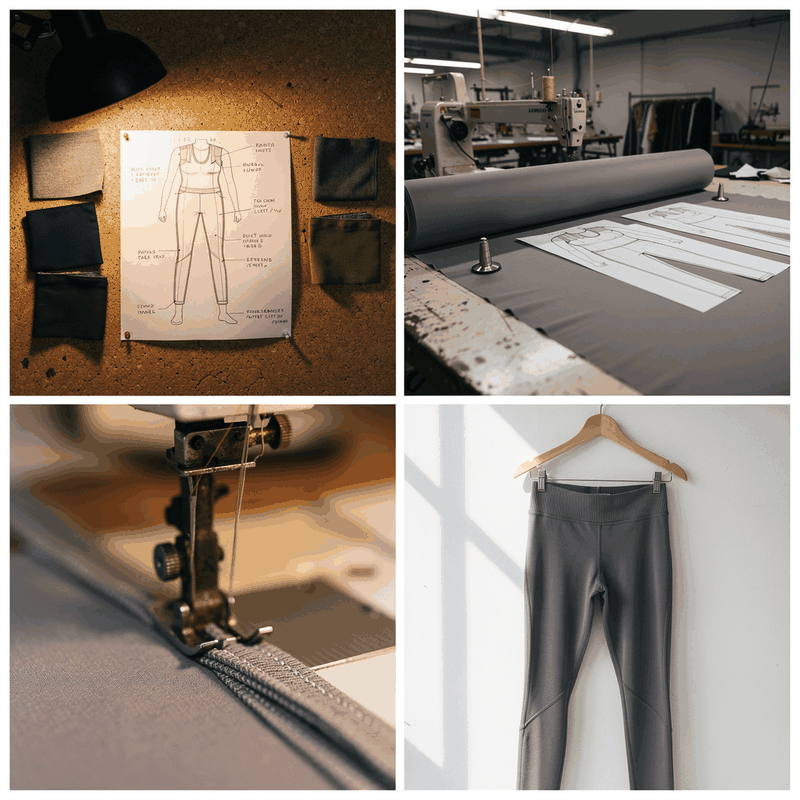
Start small. A bra, a legging, and a tank. Not a 12-piece collection. The three-SKU capsule generates two numbers: sell-through rate and return rate. Those two numbers answer whether the product is right for the brand’s existing customers and whether the quality holds to their expectations. Everything else can be adjusted after the first batch comes back with data.
The production ladder is additive. A brand can start with stock items, add custom fabric, and eventually move to full OEM without abandoning the earlier rung. Each step builds on the one before it. Starting with stock fabric lets discoveries about fit, fabric, and construction happen on a 100-unit order rather than a 600-unit order.
Certifications may carry over, but only within the same supply chain. If a brand already holds GOTS or GRS certification for its existing product lines, whether those certifications extend to activewear depends on three conditions: the new product uses the same certified materials, the same certified suppliers, and falls within the existing audit scope. The documentation infrastructure (audit trail, chain of custody records, factory certifications) provides a foundation that does not need to be built from zero. But we verify with each brand whether the new category falls within the existing scope rather than assuming it does.
The sample line is the production line. At Ziyang, the factory floor runs four technical lines: seamless knitting on Santoni machines, cut-and-sew, warp knitting, and socks. The line that produces the sample is the same line that runs the bulk order. There is no handoff between a sample room and a production floor. Custom packaging, branded hang tags, and biodegradable polybags all happen on the same floor as the sewing.
Two paths, same factory. SET ACTIVE came to us with their material story figured out. We developed the fabric for their Eco-Luxe collection together. The line sold out in three days. MILE Collective started from a different point: launched in 2023 as Mile Active with four products, built around softness and wearability for Indian bodies and climates, then expanded after Samantha Ruth Prabhu joined as co-founder (StartupTalky, January 2026). The difference between the two is where they were on the validation curve when they arrived at the factory: SET came with a proven concept, MILE was still validating the category. Both paths are valid. Both run on the same production lines.
If you are a women empowerment brand founder
Your brand’s core message does not need translation for the activewear consumer. Whether it is confidence, independence, body positivity, or self-definition, she is the same person. She already buys from you. She also practices yoga, goes to the gym, or lives in leggings on weekends. The gap is not between your brand and her. It is between your brand and the production line that makes the product she would buy if it existed.
At Ziyang, we work with brands at each stage of this journey. For a brand taking its first step, we begin by reviewing existing certifications and supplier documentation to map what already carries over into the first capsule rather than starting from a blank slate. For brands further along, we develop exclusive fabrics, allocate dedicated production lines, and build the traceability documentation that markets like the EU are already starting to require.
Tags: #womenempowerment #activewearmanufacturing #crossoverbrands #femalefounders #oemactivewear #privatelabelactivewear #yogawear #growingbrands
