

- Your consumer already trusts your materials. She just buys someone else’s leggings
- What changes when Europe turns “green” from a marketing word into a legal requirement?
- Why are Australian consumers already filtering brands by certification?
- Where does a fashion brand’s sustainability DNA actually fit into yoga wear?
- What does the first step actually look like?
Your consumer already trusts your materials. She just buys someone else’s leggings
Three numbers tell most of the story.
The first: the global yoga clothing market passed USD 31 billion in 2025 and is headed somewhere between USD 66 billion and USD 93 billion by 2034 (Fortune Business Insights, Grand View Research). That places it inside an activewear market racing toward USD 434.6 billion before 2030 (Gitnux). Large enough to matter. Not so large that the growth has played out.
The second: inside that market, sustainable yoga wear is growing at 10.5 to 11 percent annually, roughly 40 percent faster than the rest of the category (DataIntelo). By 2034, sustainable products are projected to represent 52 percent of all yoga apparel sold globally (DataIntelo). Think about that for a second: more than half. Not a niche. The direction the whole category is moving.
The third: consumers are paying for the difference. Across multiple studies, 73 percent of activewear buyers say they will pay more for sustainable products. Roughly one in three is willing to pay 25 percent more or higher (CNHaving). Sustainable yoga products command price premiums of 20 to 35 percent over conventional equivalents (YogaPeakYoga). Gross margins on sustainable yoga apparel typically run 50 to 70 percent, with net margins landing between 10 and 25 percent for a well-run direct to consumer operation (Financial Model Excel).
Taken together, those three numbers describe a market that is large, tilting fast toward sustainable, and where consumers have already demonstrated they will pay a premium for products that match their values. The question they do not answer is whether your brand’s existing sustainability infrastructure, the certifications, the material traceability, the consumer trust you already have in another category, actually carries across into this one.
Here is what those numbers mean for the consumer who already buys from you. She checks your fabric labels. She recognizes your GOTS tag. She chose your brand partly because your values and hers speak the same language. Then she goes to a yoga class. And she wears someone else’s leggings. That is not her leaving your brand. It is your brand not having shown up in that part of her life yet. The data says she is already spending on sustainable yoga wear. It just is not from you.
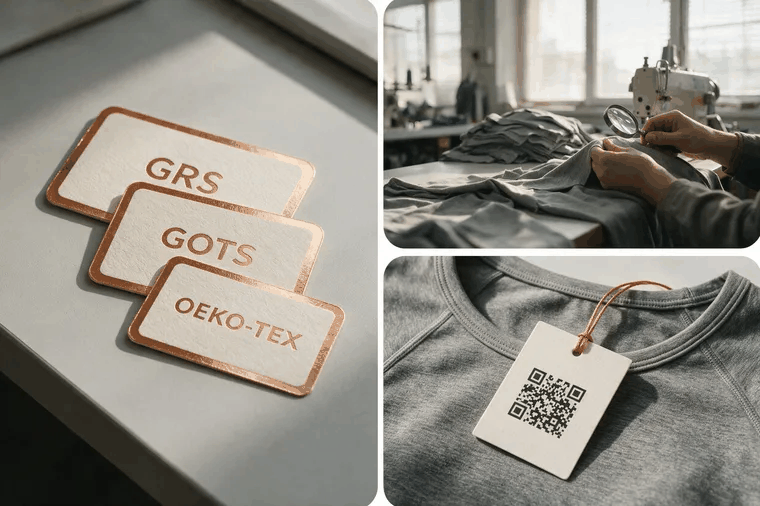
When we work with brands evaluating yoga wear for the first time, we start with that question. A brand that already sources GOTS-certified organic cotton for its main collection already has the certification chain, the supplier relationship, and the quality standards in place. The fiber does not need to change. The context does. What needs to be tested is not whether the consumer buys sustainable fashion. She already does, from you. What needs testing is whether she recognizes your brand’s values in a category she has not seen you in before.
That is the consumer side of the equation. But consumers are not the only force reshaping this category. The European Union is writing rules that will change the landscape faster than any shift in consumer preference.
What changes when Europe turns “green” from a marketing word into a legal requirement?
The EU Ecodesign for Sustainable Products Regulation, in force since July 2024, designates textiles as a priority product group (EUR-Lex). Two mechanisms deserve attention because they will determine which brands can sell into the European market and which cannot.
The first is the Digital Product Passport (DPP). Every textile product placed on the EU market will require a machine-readable digital record containing verified data on material composition, supplier identity across multiple tiers, and environmental footprint. The textile-specific delegated act is expected in 2027. Products without a compliant DPP face customs delays or market exclusion (Carbonfact, TraceX).
The second is the destruction ban. From July 2026, large enterprises may not destroy unsold apparel or footwear (Carbonfact). This changes production planning directly: brands that previously over-ordered and wrote off excess inventory now need manufacturing partners who can produce smaller batches reliably and hold certifications that satisfy both regulators and retailers.
For a brand that already sources GRS-certified recycled polyester, already uses GOTS-certified organic cotton, and already has OEKO-TEX Standard 100 compliance in its supply chain, the regulatory wave is not a threat. It is a competitive filter. The infrastructure that supports your current material claims is the same infrastructure that will satisfy the DPP’s traceability requirements. Brands that have it are not scrambling. Brands that do not have roughly eighteen months to close the gap before the delegated act lands.
Our factory floor works with all three certifications daily. Over the past two years, a pattern has become visible: the same certification set that qualifies a brand’s existing product line for European retail becomes the baseline for any new category that brand enters, yoga wear included. When a brand asks us whether their current certifications are enough to support a yoga line, the answer is almost always yes, provided the documentation is organized and the supply chain mapping is in place. The gap is rarely the certifications themselves. It is whether the paperwork trail is ready for the audit that the DPP will demand.
Europe regulates from the top down. On the other side of the world, another market is arriving at the same result from the opposite direction, pushed by consumers rather than lawmakers.
Why are Australian consumers already filtering brands by certification?
Australia takes a different route to the same destination.
The country is home to at least twelve active, growing sustainable activewear brands as of 2025, including dk active (Brisbane-based, ethically manufactured locally), Boody (bamboo-based B Corp), BAY Active (GOTS-certified, made in Sydney), and STAPLE Co (GOTS plus Fairtrade certified) (Britt’s List).
A pattern repeats across these brands. The pairing of certified organic or recycled materials with transparent manufacturing location functions as the primary consumer filter. “Australian-made” and “GOTS-certified” appear not as marketing claims but as the minimum bar for entry. The consumer who reads a fabric tag on an organic cotton dress applies the same expectation when she buys yoga wear. The filter does not change between categories.
We have shipped to brands across the Australian market. One thing has been consistent: the questions Australian buyers ask during supplier qualification are the same questions European buyers ask. Where is the fabric milled. Who does the dyeing. What is the audit status of the sewing floor. These are bonus questions in some markets. Here they are the first three.
For a brand with an established sustainability narrative, the opportunity is not convincing Australian consumers that sustainable yoga wear exists. Twelve brands already sell it to them. The opportunity is this: the supply chain that already answers those three questions for your current product line can answer them for yoga wear with the same documentation, the same certifications, and the same audit trail. The consumer who already trusts your brand does not need to be persuaded. She needs the product to exist.
But whether a brand can answer those questions depends on something more fundamental: where its sustainability DNA actually lives inside the business.
Where does a fashion brand’s sustainability DNA actually fit into yoga wear?
This is the question we spend the most time on with brands exploring this direction. The answer depends on where the sustainability DNA actually lives inside the business.
If it lives in your materials, the translation is direct. A brand that sources GOTS-certified organic cotton for everyday apparel already has the supplier, the certification chain, and the quality standards. The fiber does not need to change. The context does.
SET ACTIVE is one of the brands that came to us with a sustainability foundation already in place. They had a clear brief for what became their Eco-Luxe collection. We developed the fabric together. The line sold out in three days. The takeaway is not that every sustainable launch sells out. It is that the brands we see succeed in this transition are rarely starting from zero. They show up with a material story, a certification chain, and a consumer who already knows what their label stands for. Our job is to make sure the production line delivers on what the consumer expects.
If it lives in your supply chain transparency, the translation is operational. A brand that already documents fabric origins, dyeing processes, and sewing floor audit reports has built the data infrastructure that the EU Digital Product Passport will eventually require by law. Adding yoga wear does not mean building a new traceability system. It means extending one that already works.
If it lives in consumer trust, the translation is brand-level. The consumer who bought your organic cotton pieces also practices yoga. She is already inside your ecosystem. The missing piece is the product she would buy if it existed.
Where we see the most friction is when sustainability lives only at the marketing level. A landing page. A seasonal capsule. A tagline. That kind of claim will struggle when the DPP requires machine-readable, verifiable, multi-tier supply chain data. The gap between a sustainability story and sustainable operations is about to become audit-level visible.
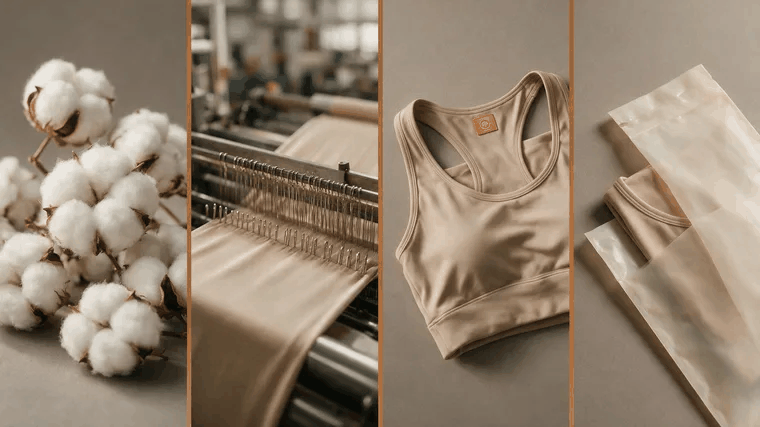
Our product development team has worked through this with brands across multiple categories. When a brand comes to us with an existing sustainability infrastructure, the material system does not need to be rebuilt. The GRS-certified recycled polyester you already use in your main collection is the same fiber that goes into your first yoga capsule. The GOTS-certified organic cotton you have been sourcing for three seasons carries the same certification chain into every new silhouette. The design work is real. New fits, new constructions, new color palettes, developed through our full OEM process: tech pack review, sampling, fit approval, dedicated production line allocation. What changes between categories is not the quality of the work. It is how much of the material foundation is already standing when the design work begins.
Once the audit is done and the infrastructure checks out, the question shifts from whether this is possible to how to start.
What does the first step actually look like?
With the audit done and the certification chain confirmed, the next move is to pick two or three SKUs that sit closest to what your brand already makes, built on the fabrics you already use, and drop them into your existing sales channel as a capsule test.
A brand that makes organic cotton loungewear does not need to launch a high-compression performance legging. A yoga tank in the same organic cotton blend, or a lounge bra with the same fabric hand feel, sits at the closest point to what the brand already does. The sizing logic, the quality standards, and the material system are already established. The only variable that changes is the consumer use context.
A bra, a legging, and a tank form a complete enough set for measuring two metrics: sell-through rate and return rate. Those two numbers answer whether the product is right for the brand’s existing customers and whether the quality holds to their expectations. Everything else can be adjusted after the first batch comes back with data.
From there, the path is incremental. What begins as a two-SKU capsule using existing certified materials can grow into a dedicated collection with exclusive fabric development. Over successive seasons, the yoga wear line can carry its own color palette and production cadence, always running on the same certification infrastructure that the main collection uses. The goal is not to add complexity. It is to extend infrastructure that already works into a new consumer context.
At Ziyang, we work with brands at each stage of this progression. For a brand taking its first step into yoga wear, we begin with the fabric certifications and supplier documentation already in place for its existing product lines and map them directly onto the first capsule. For brands further along the path, we develop exclusive sustainable fabrics under GRS and GOTS standards, with dedicated production lines, AQL-based quality inspection, and full traceability documentation that will feed into the Digital Product Passport when it becomes mandatory.
The label on the garment may change from dress to legging. The certifications that support that garment are the same. The supply chain behind it already works. The story your brand tells about how it makes things does not need a rewrite.
If your brand is already positioned around sustainability and you are evaluating whether yoga wear fits your next collection, we can walk through what your existing certifications cover, what they would need to extend, and what a first production timeline looks like. Reach out to our team with your current material certifications and we will map the path from there.
#sustainableactivewear #yogawearmanufacturer #GRScertified #GOTScertified #sustainablefashion #privatelabelactivewear
Post time: Jul-25-2026
