

The $27 legging won on consistency: what the price gap actually buys
Lululemon put its leggings up to 50% off in its July summer sale. In the same window, shoppers on Reddit rated a €37 dupe 91% positive across thousands of comments. Both signals point at the same question every yoga brand will face this season: when the price gap is that wide, what are customers actually paying for?
Why the dupe keeps winning
CRZ Yoga’s Butterluxe legging holds a 4.4/5 average across more than 17,800 Amazon reviews and sits at #1 in its category, as reported. Reddit’s aggregated legging ranking, updated June 2026, puts it at 705 upvotes with 91% positive feedback.
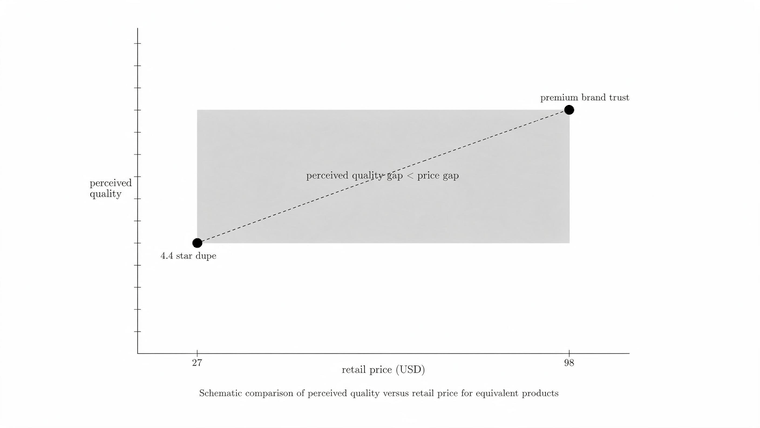
The number matters less than what it implies: when the perceived quality gap is smaller than the price gap, customers default to the cheaper option. Meanwhile Lululemon has now reported five consecutive quarters of declining same-store sales in the Americas, with gross margin down about 410 basis points to 54.2% in Q1 FY2026. Its two see-through legging incidents earlier this year (Get Low in January, Heart Scatter in February) left a trust wound that discounts do not heal quickly.
A 91% positive rating on a €37 legging tells us less about quality than about expectation: the middle of the market moved down.
If your line sits anywhere in that debate, the next section walks through where the price gap actually lives.
What the price gap actually buys
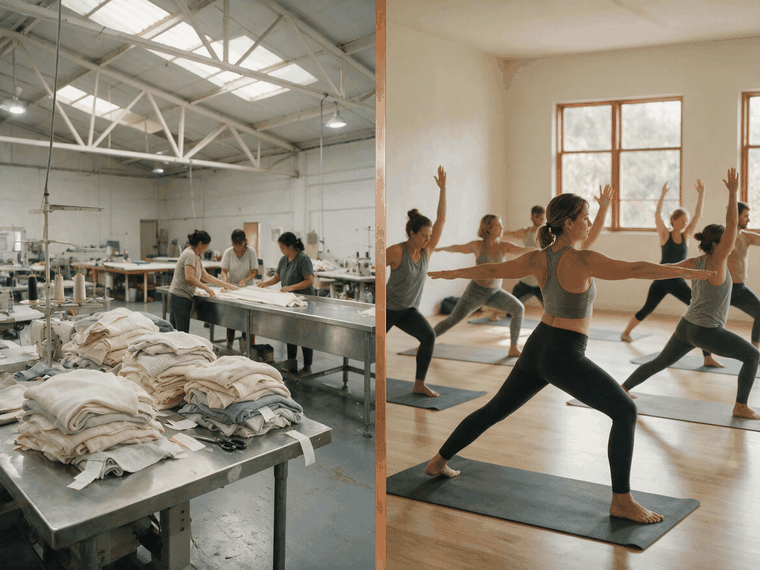
On the factory floor, we see this pattern consistently: the fabric cost difference between a $98 legging and a $27 one is a small fraction of the retail gap. The real difference sits in pattern development, QC frequency, and batch-to-batch consistency.
| Cost driver | $98 premium legging | $27 affordable dupe |
|---|---|---|
| Fabric | Higher-spec knit, similar base material | Similar base material, same mill family |
| Pattern & fit | Multiple grading rounds, fit-on-body testing | Fewer rounds, fit locked earlier |
| QC depth | Inline + pre-shipment inspection at every gate | Inspection frequency varies by order size |
| Brand & marketing | Pricing power, retail margin, marketing spend | Thin margin, minimal marketing |
The uncomfortable industry fact: the same factories supply both tiers. [PERSONAL EXPERIENCE] A dupe starts from the same fabric family, then makes different decisions about what to test and at what frequency. When a brand orders 5,000 units at $27, the supplier quotes a leaner QC scope than the same factory quotes for 500 units at $98 with a 12-point inspection list. We unpack how fabric choices drive scale in Why Fabric Innovation is the Real Secret to Scaling Your Activewear Brand.
Who gets squeezed first when giants discount
Lululemon’s July sale cut prices by up to 50%, a move that contradicts its March statement about reducing markdowns. The brands feeling that pressure first are not the premium leaders.
The $60-90 middle tier holds neither Lululemon’s trust premium nor a $27 dupe’s price advantage. That band is where most emerging yoga brands live, and it is the band being asked to justify a 2x price with no visible quality story. The discount war does not push customers from $98 to $60. It pushes them from $98 to $27, and the middle has to answer for both jumps at once.
What a yoga brand should compete on now
Apparel return rates reached 22.4% in 2026, up from 18.7% in 2024, and 53-67% of those returns trace to fit and sizing issues. For a tight-fitting category like leggings, that math puts version stability at the center of your value proposition.
What most brands miss about fit returns: they start in production, when a supplier changes fabric batches without re-grading the size chart. [PERSONAL EXPERIENCE] A new batch of knit can stretch 3-5% differently after washing, and if the size table stays the same, the customer gets a different fit from the same label. Brands that compete on “consistent fit” and can prove it with size-chart data convert returns into repeat purchases. That is a quality story a $27 price cannot copy.
How to lock quality into the spec sheet
Quality failures in production rarely come from factories that cannot meet a spec. They come from specs that were never written down. Fabric weight, elastane content, stretch recovery, and wash performance all drift when they are not fixed at purchase.
If I were placing a legging order today, I would ask for five things before sampling:
- Fabric weight in GSM, written down (a typical 230 GSM, 75% nylon / 25% spandex knit, for example)
- Elastane percentage, with a tolerance of ±2%
- Stretch recovery after wash, tested on the actual batch, not the original sample
- Squat-proof check at stretch, tested wet and dry
- AQL sampling level and inspection gates, agreed before production
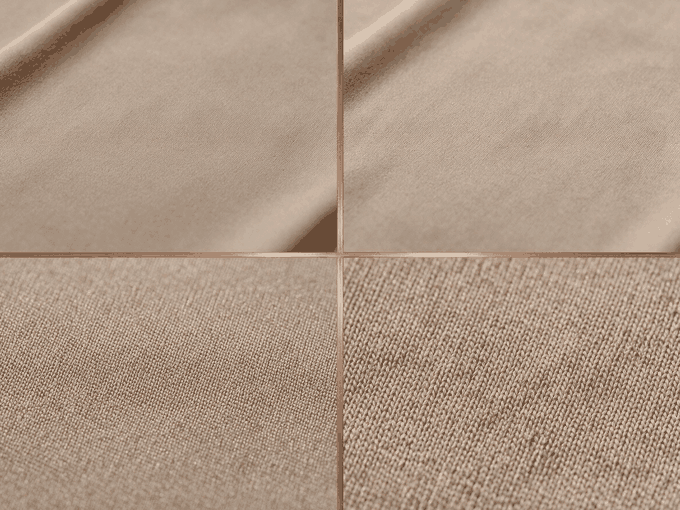
The spec sheet is where the dupe’s advantage ends. A $27 price can match a fabric spec. It cannot match a documented testing routine, because that routine is labor, and labor is the part of the price that does not scale down. When specs are left unwritten, this is what falls apart: Anatomy of a Quality Collapse.
At Ziyang, we build the QC into the price
The price war is real, but winning it looks less like a race to the bottom and more like a race to prove value with data. Logos alone cannot carry the margin anymore. [UNIQUE INSIGHT]
At Ziyang, our QC runs from incoming yarn to final packing, using ISO 2859-1 AQL sampling, with third-party testing available to SGS and OEKO-TEX standards. Our defect rate stays under 1%, and our on-time, in-full rate at 98%. That is not marketing language; it is what we write into every production plan.
If your brand is deciding what to compete on this season, start with the spec sheet and the return data. Would you like a copy of our fabric spec template to benchmark your current line?
For the development side of this decision, our earlier guide to the eight questions before your next activewear collection walks through which specs to settle before sampling.
This article was written by ZIYANG, an activewear OEM/ODM manufacturer serving 90+ brands across 70+ countries since 2013. Data cited from public retail media and Reddit aggregates, August 2026.
Further reading: Anatomy of a Quality Collapse | Why Fabric Innovation is the Real Secret to Scaling | The 8 Questions Before Your Next Activewear Collection
Post time: Aug-18-2026
