

Nike spent six years learning how to enter the yoga category. Here is what that means for your sports brand.
Yesterday, July 30, 2026, NikeSKIMS drops Studio Edit 02. Five months after the first Studio Edit launch, it arrives with its own fabric technology pipeline and a footwear line anchoring the studio wardrobe. Nike first asked whether it could win yoga in 2019. It took six years, three dead ends, and one hard pivot to get the answer.
If your running or training brand is looking at a yoga line right now, those six years are basically free R&D. You don’t need to run the same experiment. You just need to know what Nike tried, where each swing missed, and what a manufacturing setup built for yoga actually looks like on the factory floor.
Nike’s six years: three attempts, one conclusion
January 2019. Nike drops its first yoga collection. The campaign stars an NFL linebacker, a WNBA player, a sprinter, a skateboarder — the pitch is “yoga makes you a better athlete.” The collection doesn’t land. Yoga buyers already know yoga helps their game. What they want is gear that gets what a yoga body actually does.
Adidas tries a different play in 2022 with Make Space: “Yoga is for all,” priced under Lululemon to grab volume. Same result. Lululemon’s yoga line keeps outselling on both volume and full-price sell-through. These shoppers weren’t looking for a deal. They were buying from the brand they trusted in the category.
February 2025. Nike stops trying to build yoga cred from zero. Instead it partners with SKIMS — the brand that already owns body confidence and sculpting in culture. NikeSKIMS launches as a standalone entity: Nike’s sport science and supply chain, SKIMS’ fit DNA and cultural authority. Not a sub-brand tucked under a bigger one.
Three swings, six years. The bottleneck was never manufacturing — Nike runs one of the most advanced supply chains on earth. The bottleneck was product logic and whether consumers would take yoga seriously from a brand they knew for something else. Both of those live in the factory, not the marketing deck. If your brand already has a supply chain in running or training, the real question isn’t “can we make yoga apparel.” It’s “is our manufacturing floor set up for what yoga actually asks of a garment.” That starts with fabric.
(We dug into the link between fabric development and brand scaling in Why Fabric Innovation is the Real Secret to Scaling Your Activewear Brand. This piece picks up from there, focused on what changes when you add yoga to the mix.)
The fabric gap between running and yoga
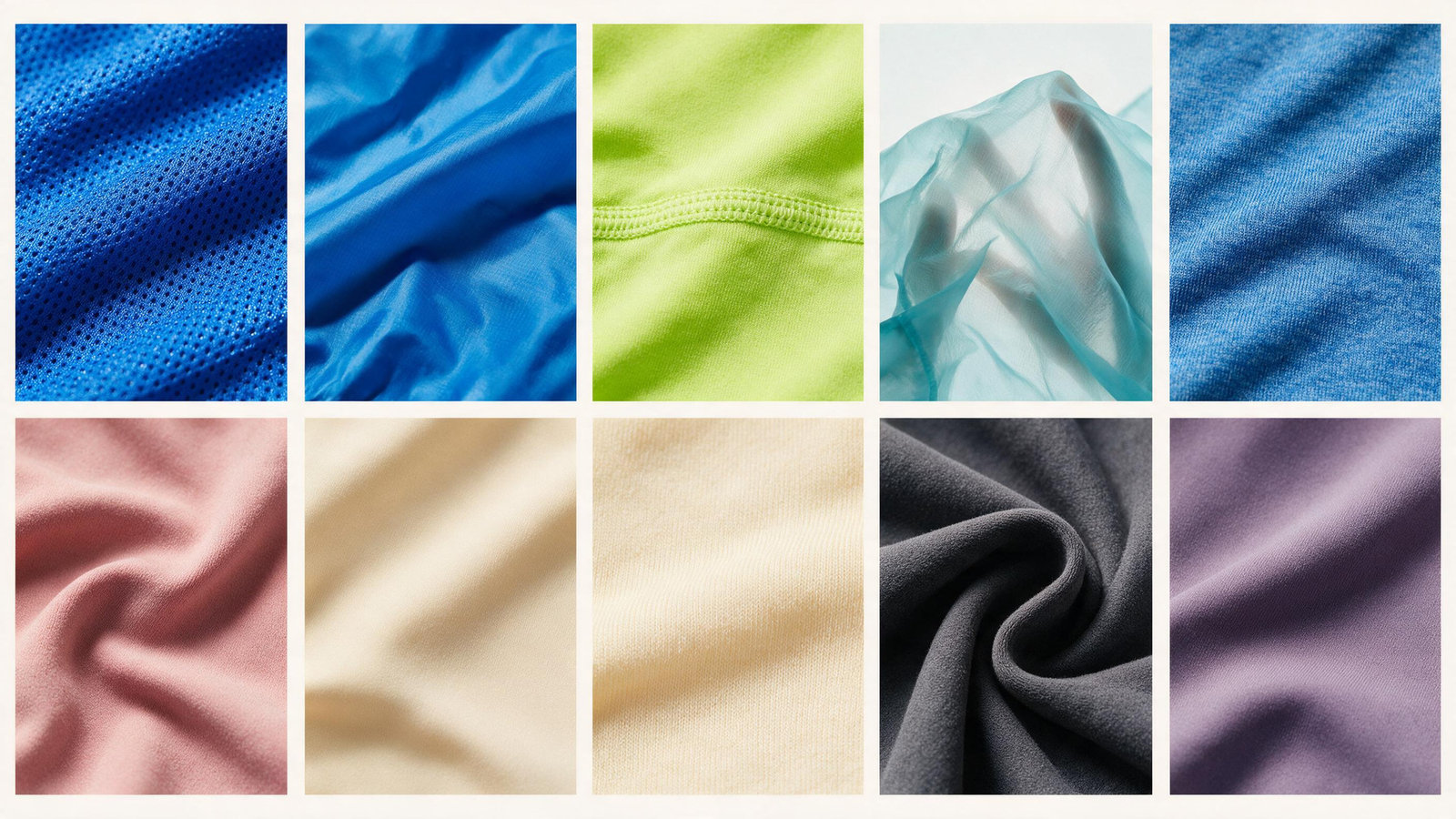
A supply chain tuned for running gear is dialed into one set of material behaviors. Yoga wants a different set. Here’s the fabric gap on the things that actually matter on the cutting table:
| What the garment needs | Running gear | Yoga gear |
|---|---|---|
| Compression | Medium to high — cuts muscle oscillation at speed | Light to none. A forward fold in high-compression tights feels terrible |
| Hand feel | Light, fast-drying, wind-ready | Second-skin soft, matte surface. If it looks shiny on the rack, it won’t sell to this buyer |
| Seam construction | Flatlock at friction points to cut chafing | No front rise seam on leggings, period. Fewest seams possible. Seam-free wherever the machine allows |
| Fabric weight | 80–150 GSM ultralight shells | 120–450 GSM. Heavier end keeps things opaque in a deep lunge and gives the fabric some sculpting heft |
| Typical fiber blend | Polyester mesh, recycled poly, Dri-FIT and its siblings | Nylon/Spandex around 80/20, Tencel blends, Rayon. You almost never see polyester in premium yoga |
These aren’t just spec sheet differences. They pull in different machines. A running factory runs Cut and Sewn lines built for multi-panel construction with zoned ventilation panels. A yoga factory runs seamless circular knitting — Santoni or equivalent — spitting out tubular fabric that wraps 360 degrees with barely any cutting waste.
At ZIYANG, we keep both under one roof: Santoni seamless next to Cut and Sewn, plus warp knitting and socks. For a brand crossing categories, your running line stays on Cut and Sewn, your yoga line moves to seamless — with warp knitting available for mesh panels and breathable zones where the design calls for it — and you’re not juggling two factories with two different QC teams. Our floor runs at 98% on-time in-full, under 1% defect rate.
Your fit system was built for a different body
Running brands build their fit around forward motion. A running bra locks everything down for high-impact, repetitive force. Running tights map graduated compression to muscle groups that fire when you’re striding. Perfectly logical — for running.
Then someone puts your yoga leggings into downward dog. Or a forward fold. Or shoulder stand. Or a deep twist. These are positions your running fit system was never tested against, and the complaints come fast: waistband rolling down, straps sliding off shoulders in inversion, fabric going sheer across the hips in a lunge.
Three things that are standard spec in yoga manufacturing and completely absent from most running Tech Packs:
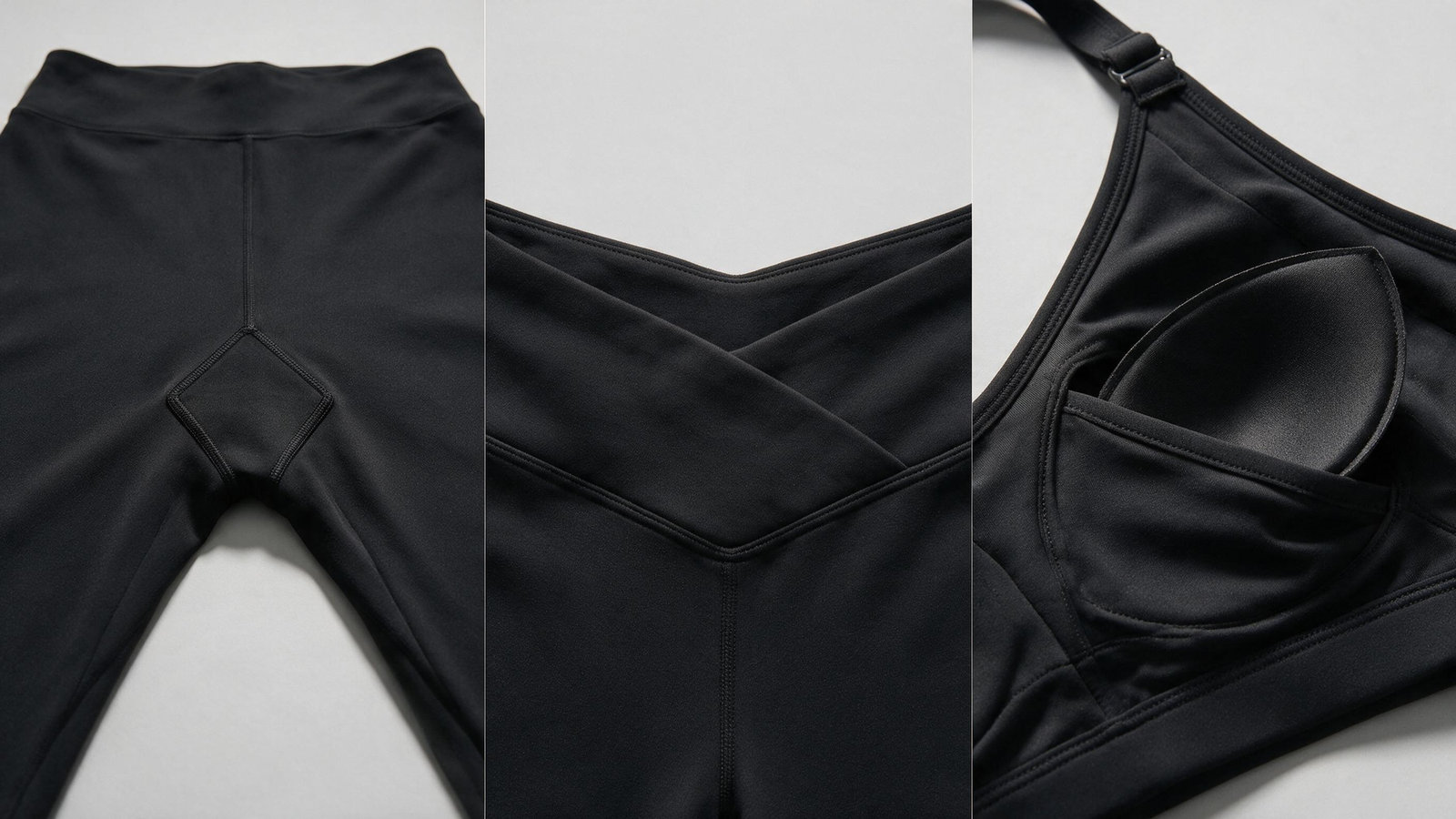
The gusset. A diamond-shaped panel sewn into the crotch of yoga leggings that eliminates the center seam running straight through a high-friction, high-visibility zone. Running tights rarely include one because forward motion spreads pressure differently — the center seam isn’t a problem when you’re upright and moving in one plane.
The V-waistband. Instead of a straight elastic band, the front waist dips lower at center and sits higher at the sides. Follows the abdomen’s natural shape, which means it stays put during forward bends. Running tights use a straight waistband because runners stay vertical. Nobody’s doing sun salutations at mile four.
Adjustable, removable cup construction. Yoga bras are low-impact. The support comes from how the fabric encapsulates each breast, not from underwire or high-compression elastic. Cups come out, straps adjust for different poses. A running bra prioritizes locking things in place — adjustability is secondary because the movement pattern is predictable.
These go into the Tech Pack before the first sample gets cut. If your design team has never written a yoga Tech Pack, round one of sampling will produce a garment that looks like yoga and fits like a 5K.
Six questions to ask your current supplier
Before you sink development money into a yoga line, walk these questions into your next supplier call. If the answers sound like “we can figure it out,” what you’re really hearing is “we’ll learn on your timeline and your budget.”
1. Do you have seamless knitting machines? What brand, how many?
Seamless circular knitting — Santoni is the name you’ll hear most — is what premium yoga wear is built on. A Cut and Sewn-only factory can technically sew yoga apparel. They just can’t do the 360-degree, nearly seam-free construction the category runs on. Your product ends up competing against brands whose machines actually match what yoga shoppers expect.
2. Do you do warp knitting? Walk me through what makes yoga warp-knit different from sportswear warp-knit.
Warp knitting beats weft knitting on durability and stretch, which is why you see it in both performance sportswear and premium yoga. But the difference is in the yarn, the stitch density, and the finishing. Yoga warp-knit needs a softer hand and a matte face. Sportswear warp-knit goes for compression and sheen. If your supplier treats them as the same thing, your yoga fabric comes out feeling like gym gear — and this buyer notices fabric before they notice price.
3. Is squat-proof testing part of your sampling process?
There’s no skipping this one. A buyer who discovers her leggings are see-through mid-class doesn’t quietly return them — she posts about it. Ask whether squat-proof testing is a standard QC gate before bulk production, not a “we can check if you want” add-on. If the answer is fuzzy, you’re gambling.
4. Does my MOQ change when I add this category?
New fabric means a new dye lot. New dye lot means a minimum order from the dye house. Even if your running line comfortably sits at 600 pieces, your first yoga run might carry a higher floor because the fabric is new to your supplier’s inventory. Get the number now, not when you’re ready to cut the PO. (We wrote a longer piece on how MOQ looks from the factory side: How Low Is Too Low: What a Sportswear Factory Wishes Startups Knew About MOQ.)
5. Can you run both categories on the same calendar without one pushing the other?
Two lines, two sets of machines, one factory floor. Seamless machines can’t pick up Cut and Sewn work, and vice versa. If your supplier’s production planning doesn’t explicitly assign machines to each line, your yoga launch timeline slides the moment your running line needs a reorder. Ask how they allocate capacity between the two.
6. Do your certifications cover my target market?
OEKO-TEX Standard 100 is the floor for skin-contact safety. GRS covers recycled content claims. GOTS handles organic fiber. For US market, you need CPSC compliance. If your supplier’s cert scope doesn’t stretch to your target region, you’re carrying compliance exposure that your running line’s paperwork may not cover.
ZIYANG holds GRS, GOTS, OEKO-TEX, BSCI, SA8000, and ISO9001-F. Whether that covers the US, EU, or Australia depends on the specific materials, suppliers, and audit scope per product. Point is: your current supplier should be able to answer this question without a long pause. If they can’t, that’s data.
Where category entry actually starts
The single biggest lesson from Nike’s six years: test whether your existing audience wants yoga from your brand before you commit to a full custom line. For a brand that already has production infrastructure, you can skip the pure stock-sample phase and start with custom fabric. The path breaks into three levels.
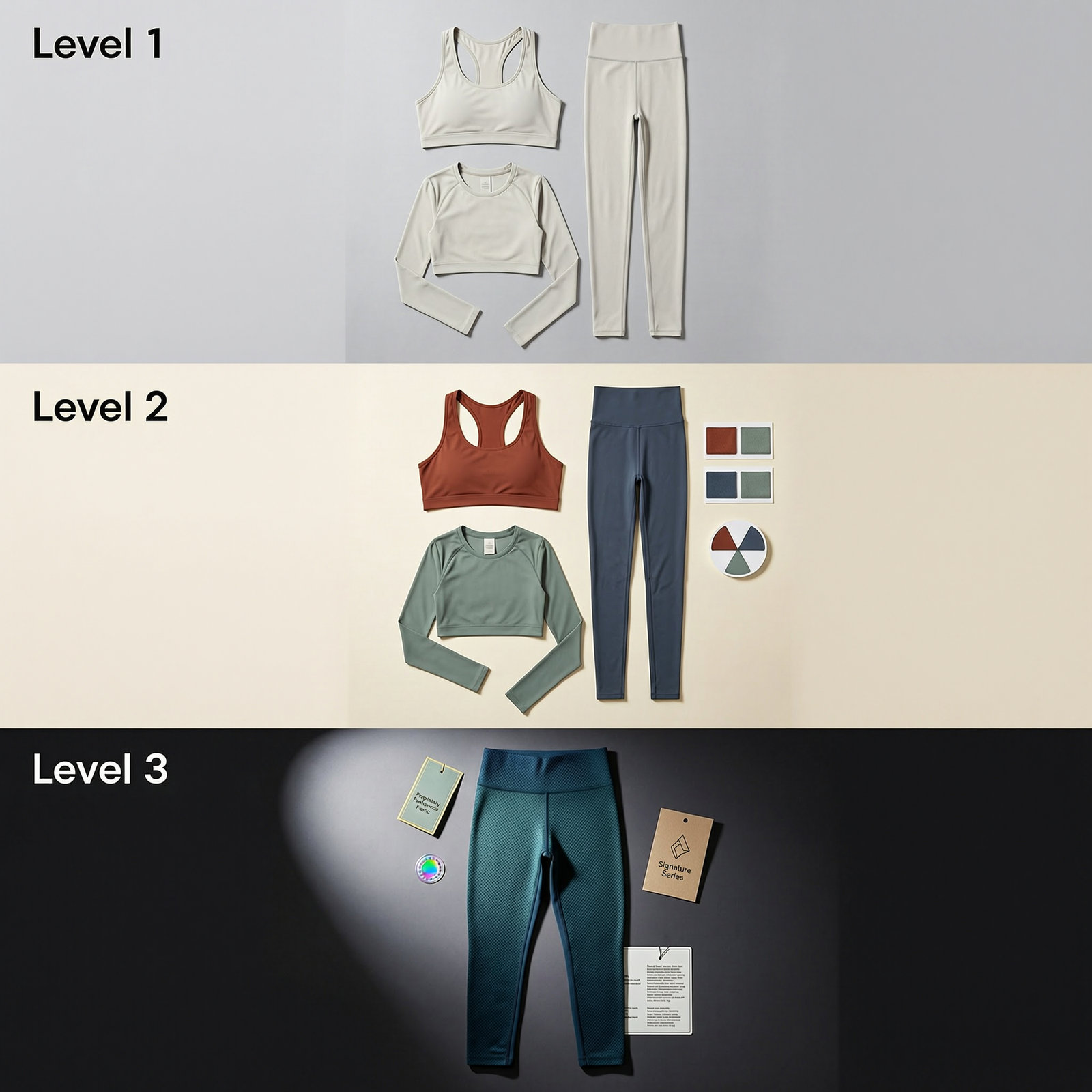
Level 1: Market validation. Grab two or three styles from your supplier’s stock fabric catalog — a bra, a legging, a cropped top. Slap your branding on them. Order 100 to 200 pieces per style. Samples in seven days. Put them in front of actual customers. Speed matters more than perfection here. You’re checking whether demand exists before burning development budget. At ZIYANG, this is exactly what our stock fabric Low MOQ track is for.
Level 2: Brand control. Once the market signal is there, move to custom fabric: 600 to 800 pieces per color per style, your palette, your fit specs in a real Tech Pack. This is where your running brand’s DNA gets translated into yoga product language — and where having a supplier who actually understands both categories stops being nice-to-have and starts mattering.
Level 3: Competitive moat. Custom fabric plus proprietary color development plus your own certification stack. At this stage you’re running a second category with the same manufacturing depth as your first. The proprietary fabric that sets you apart on your DTC site also becomes a wholesale barrier — generic competitors can’t copy what they can’t source.
Two brands that moved through these levels with us: Sarah M., Purchasing Manager at SET ACTIVE, told us “Ziyang didn’t just produce our designs; they improved our fabric choices. Our Eco-Luxe line sold out in 3 days.” MILE Collective started at Level 1 and grew past 5,000 pieces. Neither launched at Level 3. Both got there by starting at the level their audience was actually at.
Adding a yoga line means adding a second set of manufacturing requirements, a different fit philosophy, and a new checklist for your supplier. Nike burned six years and three strategies figuring this out. You can get there before the first sample round — if you ask the right questions at the right time.
ZIYANG works with 90-plus brands across 70-plus countries from one production floor: Santoni seamless, Cut and Sewn, warp knitting, and socks all running side by side. Stock fabric Low MOQ through full custom development — the path is there when you’re ready. Reach out to our team for a custom quote on your next collection.
Next read: how to evaluate whether your brand DNA translates to the yoga category, before you invest a single dollar.
