

Can Your Brand Grow Without a Factory Behind It?
Southeast Asia’s activewear market is heading toward $10.1 billion by 2029. TikTok Shop grew 66% in 2025 alone. The region is attracting more foreign direct investment than China for the first time in a decade. And yet, something is missing. The factories are rising, the orders are flowing, but the supply chain that feeds them has not kept pace. For brands building in this region, that gap is the difference between surviving a price war and capturing the premium end of a booming market.
- Why are Southeast Asian consumers cutting back but still spending more on activewear?
- What’s really happening behind SEA’s manufacturing boom?
- How do you deliver premium feel at a market-stall price?
- Why the world’s biggest brands are leaving China, and why that’s good news for your startup
- What a supply chain built for growth actually looks like
- The market is not waiting
Why are Southeast Asian consumers cutting back but still spending more on activewear?
The numbers tell two different stories at once.
According to Bain & Company and NielsenIQ’s 2025 consumer survey across SEA-6 markets, 43% of consumers are cutting back on non-household spending. Another 42% are actively searching for the same products at lower prices. A quarter have already switched brands in pursuit of better value.
But here is the other side: the same report found that consumers are selectively spending more on categories they consider “better-for-me.” Beauty, baby care, pet care, and health-related products are capturing disproportionate wallet share. The activewear category sits at the intersection of health, wellness, and daily lifestyle, which means it benefits from both the volume play and the premium play, but only if the product gets the value equation right.
What this means for brands is straightforward. The Southeast Asian consumer is not simply cheap. They are deliberate. They will pay for fabric that feels good at the end of a humid day. They will pay for a fit that actually works for an Asian body, not a scaled-down Western pattern. They will pay for a set that looks good enough to wear from a morning run to an afternoon coffee. But they will not pay for a logo alone. The product has to justify the price.
This is where the supply chain problem starts.
What’s really happening behind SEA’s manufacturing boom?
Vietnam, Cambodia, and Indonesia are not short of garment factories. Vietnam’s textile and garment exports reached roughly $46 billion in 2025. The country has become the go-to production base for everyone from Nike to Uniqlo. In 2025, for the first time in five years, Bangladesh fell behind Vietnam in apparel export volume.
But here is what those factories are actually doing: assembly.
The fabrics, the technical textiles, the performance yarns, the specialty trims. Most of it still comes from China. Nikkei Asia reported in July 2026 that Japan’s clothing imports from China fell below 50% for the first time, but the shift was into Vietnamese and Cambodian assembly lines, not into locally sourced materials. The upstream: knitting, dyeing, finishing, and technical fabric development remain concentrated in China.
Bain & Company confirmed this in their November 2025 report: Southeast Asia attracted more FDI than China for the first time in ten years, much of it going into manufacturing. Vietnam alone has seen over $4.6 billion in FDI textile projects since 2018. Yet the region still imports the majority of its performance fabrics and specialized trims from China.
For a local brand, this creates a structural cost problem. You are paying for imported fabric, paying for imported trims, paying a factory that is optimized for 50,000-unit runs, and then trying to sell through a TikTok Shop where the consumer benchmarks your product against a $3.50 mass-market piece.
The math does not work unless you collapse the supply chain.
How do you deliver premium feel at a market-stall price?
The answer is not cheaper labor. Vietnam’s wages are rising. Indonesia’s are rising. Cambodia’s minimum wage increases annually. The cost advantage that attracted fast fashion twenty years ago is eroding.
The real answer is supply chain efficiency. Specifically, three things:
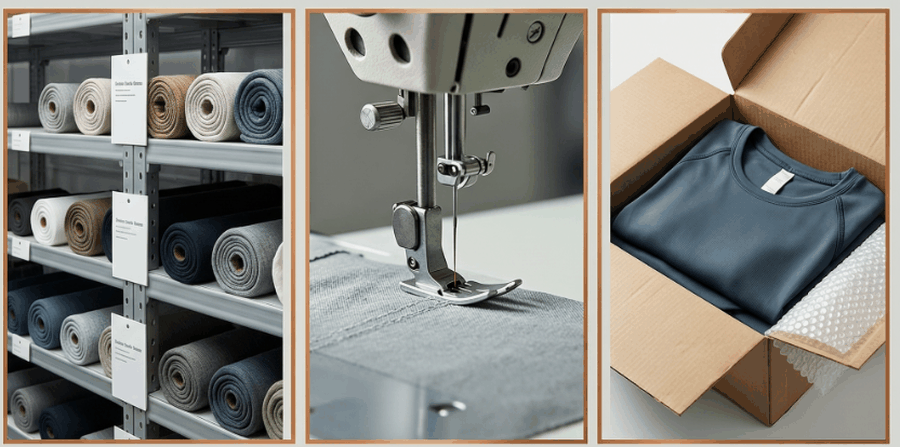
1. Direct fabric access. When a brand works with a manufacturer that controls its own fabric sourcing, develops its own material relationships, and stocks performance textiles in-house, the cost of fabric drops. There is no middle trader marking up every meter.
2. Integrated production. A factory that handles knitting, cutting, sewing, and finishing under one roof eliminates the logistical friction (and cost) of shuttling half-finished garments between specialist facilities. This is especially critical for activewear, where technical seams like flatlock require calibrated equipment that not every cut-and-sew shop has.
3. Low MOQ flexibility. A brand testing a new silhouette on TikTok Shop does not need 2,000 units. It needs 100 to 200 units in two colors, with the option to scale to 5,000 if the video takes off. Factories that build their lines around small-batch flexibility, and that maintain in-house fabric stock rather than ordering per PO, make this possible without surcharge pricing.
These three factors together create the price-to-value ratio that Southeast Asian consumers are looking for. Not cheap. Efficient.
| Variable | Traditional SEA Sourcing | Integrated China-Based Sourcing |
|---|---|---|
| Fabric sourcing | Imported from China via trader, 2 to 3 layers of markup | Direct mill relationships, in-house stock |
| Production flexibility | Optimized for 5,000+ unit runs | 100 to 200 unit MOQ with scale-up path |
| Development speed | 3 to 4 weeks for sampling due to material lead time | 7 to 15 days with in-house fabric library |
| Technical capability | Cut-and-sew basics | Seamless knitting, flatlock, ultrasonic bonding |
| Certification support | Factory-level only | Product-level GRS, GOTS, OEKO-TEX |
Why the world’s biggest brands are leaving China, and why that’s good news for your startup
The headlines are everywhere. Oxford Industries reduced its China sourcing from 40% to 15% in a single year. Abercrombie & Fitch now sources from 16 different countries. Gildan is building a second textile complex in Bangladesh. The average U.S. apparel tariff rate reached 35.1% in December 2025, and the full sourcing realignment, according to Dr. Sheng Lu at the University of Delaware, takes 12 to 18 months.
The mega-brands are leaving China because tariffs make the unit economics unworkable at their scale. A 35% duty on 500,000 units is a balance-sheet event. They have the volume, the lead time, and the supplier relationships to make Vietnam or Bangladesh work.
Your brand almost certainly does not.
If you are producing 200 to 2,000 units per style, the math flips. The factory in Vietnam that runs 50,000-unit minimums does not want your order. The factory in Bangladesh that is optimized for basic knitwear cannot execute the four-way stretch seamless set you need for a TikTok Shop launch. The factory in Cambodia that delivers consistent quality requires a fabric supply chain that takes four weeks just to source materials, while your audience expects restocks in seven days.
For small and mid-sized brands in Southeast Asia, China remains the most practical manufacturing partner. Not despite the tariff headlines, but because of the structural advantages those headlines obscure. Speed. Technical depth. Supply chain integration. Low-MOQ tolerance.
This is not an ideological argument. It is a practical one. The brands that are winning on Shopee and TikTok Shop are not the ones with the lowest factory price. They are the ones with the fastest development cycles, the most consistent quality, and the best fabric feel at their price point. Those three things come from manufacturing capability, not from geography.
| Factor | Mega-Brand Path | Startup Brand Path |
|---|---|---|
| Primary concern | Tariff exposure | Speed to market |
| Order volume | 50,000+ units | 200 to 2,000 units |
| Supply chain timeline | 12 to 18 months to relocate | 2 to 4 weeks to restock |
| Factory requirement | Scale + cost efficiency | Flexibility + technical capability |
| Best manufacturing fit | Vietnam, Bangladesh, Cambodia | China (integrated, low MOQ) |
What a supply chain built for growth actually looks like
Talk to any brand that has scaled from 100 units to 5,000, and they will tell you the same thing: the manufacturer that got you through the first 100 units is rarely the one that can handle 5,000. And the manufacturer that wants 5,000-unit minimums will not talk to you at 100.
The solution is not one factory. It is a manufacturing ecosystem that lets you move up without starting over.
At Ziyang, we structure this as four production tiers. You can enter at any level and move up as your brand grows:
Stock items with no minimums. Ready-made activewear silhouettes in our in-house fabric library. You pick colors, add your logo, and ship. This is where brands test their first market response without committing to a full production run.
Fabric customization at 100 to 200 units. Same silhouettes, but now you choose from our stocked performance fabrics: moisture-wicking, four-way stretch, compression, seamless. This is where a brand that proved demand on TikTok scales to its first real production batch.
Full OEM at 600 to 800 units per color. Your design, your fabric, your fit. Full size grading, custom packaging, and branded trims. This is where a brand that has found product-market fit builds its permanent collection.
Eco-conscious production at roughly 1,000 units. GRS-certified recycled polyester, GOTS-certified organic cotton, biodegradable packaging. This is where a brand that has built its audience on performance now adds sustainability credentials that actually mean something, with certifications that hold up to consumer scrutiny.
These tiers are not theoretical. They describe how actual brands have grown with us.
MILE Collective started at the fabric customization tier, testing small batches before committing to inventory. As their audience grew, they moved up to full OEM, eventually scaling to 5,000-unit orders per style. They never had to switch manufacturers. As their founder told us, the low-MOQ tier “allowed us to test the market without bankruptcy risk.”
CSB moved its production from Vietnam to Ziyang two years ago. The concern was whether quality consistency would hold across large volumes. It did. Across 500,000 units, the quality remained, in their words, “impeccable.” For any brand currently sourcing inside Southeast Asia and running into consistency issues as volume scales, this is the proof point that the right Chinese manufacturing partner delivers outcomes the local factory could not.
SET ACTIVE partnered with us to develop an eco-luxe fabric line. The collection sold out in three days. As their team put it: “Ziyang didn’t just produce our designs. They improved our fabric choices.” That speed of sell-through came from two things: a fabric that consumers could feel the difference in, and a manufacturing pipeline that could turn concept into product fast enough to capture the moment. For a TikTok Shop brand where a three-day window is the difference between a hit and a miss, that pipeline matters.
The point is not that every brand needs all four tiers. The point is that you should not have to change manufacturers every time your volume doubles.
We work with over 90 brands across 70-plus countries. Some started with 100-piece orders. Some run 500,000-piece programs. What they share is the ability to scale production complexity at their own pace, without rebuilding their supply chain from scratch each time.
The market is not waiting
Southeast Asia’s activewear market will grow from $7.5 billion to over $10 billion before this decade ends. The platforms (TikTok Shop, Shopee, Lazada) are creating discovery-to-purchase loops that did not exist three years ago. Local brands now command more than half of the region’s FMCG market, according to Bain. The consumer demand is real, the distribution channels are mature, and the window for new brands is open.
What is missing is the manufacturing infrastructure to convert that demand into product at the speed, quality, and price point that Southeast Asian consumers now expect. That infrastructure exists. It just happens to be in China. The brands that figure this out first will be the ones capturing share while everyone else is still figuring out their fabric lead times.
If your brand is building in Southeast Asia, the question is not whether to manufacture in China or somewhere else. The question is whether your current supply chain can deliver the speed, flexibility, and margin structure you need to compete on a platform that rewards the fastest, not the cheapest.
We have spent more than a decade building exactly that kind of supply chain. If you want to talk about what that could look like for your next collection, we are ready.
Sources: Bain & Company / NielsenIQ “Southeast Asia Consumer Products Report” (Nov 2025); Cube Asia Tradewinds Q4 2025 (Jun 2026); Momentum Works “Ecommerce in Southeast Asia 2026″; Dr. Sheng Lu, University of Delaware (Mar 2026); Dr. Sheng Lu (Apr 2026); Nikkei Asia (Jul 2026); Nikkei Asia (Oct 2024); Nikkei Asia (May 2026). ZIYANG capability data from activewearoem.com.
Post time: Jul-20-2026
