

A 2025 survey of 2,000 Canadian consumers found that only 16 percent trust fashion brands to be honest about their sustainability claims. Sixteen percent. The other 84 percent are either skeptical or actively doubtful. This is the starting point for any brand thinking about building a sustainability narrative: your customer is probably not ready to believe you. [1]
The skepticism has a basis. The Changing Markets Foundation reviewed sustainability claims across the fashion industry and found that 60 percent were misleading or unsubstantiated. Across Europe, the European Commission examined environmental claims and found that 53 percent were vague, misleading, or unfounded, with 40 percent completely unsubstantiated. Regulators are responding: between 2020 and 2025, fashion brands incurred approximately 41.9 million euros in documented greenwashing penalties, with 73 percent of that total imposed in 2024 and 2025 alone. [2][3][4]For activewear brands, this creates both a problem and an opportunity. The problem is obvious: saying "we use sustainable fabrics" carries little weight today, because consumers have heard it from everyone and trust no one. The opportunity is less obvious but more important: because most brands are vague, being specific makes you stand out immediately.The data from 2025 consumer surveys points to a clear path forward. This article maps the specific decisions that separate a credible sustainability story from one consumers scroll past.
A 2025 global survey by Cotton Incorporated, conducted across 13 countries with over 13,000 respondents, found that 36 percent of consumers rely on a sustainability certification or seal to determine whether clothing is environmentally friendly. The rest rely on brand descriptions, website imagery, or store displays, none of which are independently verifiable. [5]
The reason certifications matter is structural. Anyone can check whether a GOTS-certified product appears in the GOTS database. No one can check whether "eco-friendly" means anything.
For activewear specifically, the certifications your customers are most likely to recognize fall into two groups.
Fabric certifications address what the material is made from and how it was produced.
- GRS (Global Recycled Standard) verifies recycled content and tracks it through the supply chain. A garment labeled "GRS-certified recycled polyester" means the fiber source, production route, and recycled percentage have all been independently audited.
- GOTS (Global Organic Textile Standard) covers organic fiber from harvest to finished product, including environmental and social criteria. It addresses not just the cottonbut the dyes, the finishing chemicals, and the factory conditions.
- OEKO-TEX Standard 100 tests for harmful substances across every component of a garmentfrom thread to zipper to print. It is the most common certification consumers encounter on hang tags.
Product-level transparency is the second category and the one most brands skip. It is not a certification badge. It is the practice of telling the customer exactly which standard applies to which part of the product.
The practical rule for a growing brand: start with one certification that matches your most important product claim, disclose it specifically on that product's page, and add certifications as your production scale allows. A brand with one GRS-certified recycled polyester legging and honest disclosure about what is and is not certified will read as more credible than a brand that applies "sustainable" to its entire collection without a single verifiable standard behind it.
2. Why Performance and Sustainability Aren't a Trade-Off Anymore
In 2025 research published in the Journal of Global Fashion Marketing, both functionality and sustainability positively influenced sportswear purchase intentions. Consumers do not want to choose between performance and conscience. They expect both in the same garment. [6]
A 2025 global consumer study commissioned by SHEIN, surveying 15,461 respondents across 21 markets, found that 47 percent define sustainable clothing first and foremost by durability and long-lasting quality, ahead of low-impact materials at 38 percent. For activewear specifically, 36 percent of consumers reported wearing items more than 50 times before retirement, with an additional 17 percent reporting 31 to 50 wears. While the study comes from a company with a commercial interest in defining sustainability as durability, the finding aligns with broader consumer research: shoppers judge sustainability by what survives their workout, not by what the fiber label promises. [7]
This changes how a brand should talk about sustainable materials. Lead with performance and add certification as proof. "This fabric performs, and here is the certification that proves it was made responsibly" tells a complete story. "This fabric saves the planet" tells none.
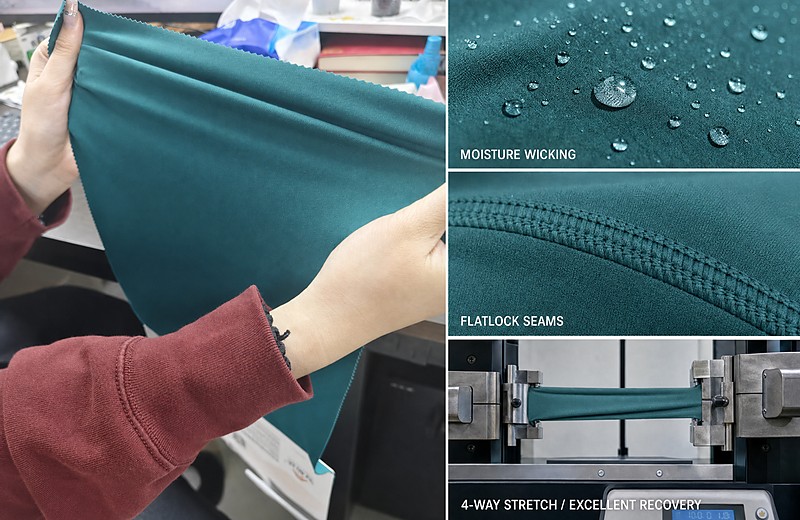
The sustainable fabrics available to activewear brands today each carry different performance characteristics. Recycled polyester performs nearly identically to virgin polyester in moisture wicking and durability, and it can carry GRS certification. Regenerated nylon matches virgin nylon in stretch recovery and abrasion resistance. Organic cotton breathes like conventional cotton but comes with a GOTS certificate your customer can independently verify. Bamboo fiber offers a soft hand-feel and natural antimicrobial properties, though its sustainability claims depend heavily on the processing method used to turn bamboo into fabric.
3. Sustainability needs its own runway
The impulse to try sustainable production at different stages of growth is entirely reasonable. A D2C startup wants to test the market with one recycled legging. An established brand wants to migrate a bestseller to certified fabrics, one SKU at a time. These are real needs.
But the production logic of sustainable fabrics differs from conventional ones. GRS-certified recycled polyester requires full chain-of-custody traceability from fiber source to finished product — it cannot share warehouse space with conventional polyester. GOTS organic cotton must run on separate dyeing lines, or cross-contamination voids the certificate. Biodegradable packaging materials need independent temperature and humidity controls. This is not about factory preference. It is about certification audit requirements: once the traceability chain is mixed, the certificate does not hold.
That is why ZIYANG chose not to sprinkle sustainability across every production tier, but to build a dedicated line for it:
| Area | Eco-Friendly Line Specs |
|---|---|
| Certified Fabrics | GRS-certified recycled polyester, regenerated nylon (ECONYL), GOTS-certified organic cotton, bamboo fiber |
| Chemical Safety | OEKO-TEX Standard 100 testing, batch-level independent lab submission |
| Trims & Accessories | Coconut shell buttons, recycled PET zippers, FSC-certified hang tags (soy-based ink) |
| Packaging | Cornstarch biodegradable bags (PLA+PBAT), recyclable outer cartons |
| Factory Compliance | BSCI social audit, SA8000 social accountability, ISO9001-F quality management |
| Energy | On-site solar power, low-water-consumption dyeing |
These six certifications (GRS, GOTS, OEKO-TEX, BSCI, SA8000, ISO 9001-F) cover different audit scopes—ranging from fiber traceability to chemical safety, and from labor rights to quality management. Every batch of fabric, every batch of trims, and every batch of finished products must undergo separate testing and documentation processes. The minimum order quantity is higher than that of conventional production lines because these fixed costs are spread across individual units; with lower volumes, the production line becomes uneconomical.Dedicated production lines offer brands a low-risk way to enter the sustainable product market: conventional orders continue to be fulfilled by existing production lines, while GRS recycled material SKUs are scheduled separately on controlled, eco-friendly production lines, facilitating material segregation, document traceability, and certification management. D2C startups do not need to convert their entire collection to sustainable products all at once; they can start with a trial order for a single GRS-certified recycled polyester leggings SKU. Established brands can also gradually transition their best-selling items on a per-SKU basis. This allows brands to first gauge market response before expanding the proportion of sustainable products.
4. The half of sustainability your customer can touch
Fabric certifications get the attention. Packaging, hang tags, buttons, and zippers constitute the other half of sustainable production, and they are what a customer actually experiences when they open the package. A garment that arrives in a biodegradable cornstarch bag with coconut shell buttons and a recyclable hang tag does not require the customer to interpret a certification logo. They can see the difference. They can feel it. The unboxing experience turns an abstract sustainability claim into something tactile.
These accessory choices also carry their own sustainability logic. Biodegradable packaging eliminates the most common consumer guilt point in online shopping: the plastic bag that goes straight to the bin. Coconut shell buttons replace petroleum-based plastics with an agricultural byproduct. Recyclable hang tags close the loop on the paper component of the product. None of these changes require recertification or retooling. They are available now, at standard production volumes.
For brands building their sustainability narrative, accessories offer a storytelling advantage that fabric cannot match. The customer opens a box. The bag inside is compostable. The hang tag says "made with GRS-certified recycled polyester, packaged in biodegradable cornstarch." That sequence tells the story more effectively than any product page paragraph.

5. What this means for your brand
The activewear sustainability conversation has been dominated by fiber companies telling brands what materials to use. That perspective answers the question "what is available." It does not answer the harder question: how to tell a sustainability story that customers actually believe.
The data from 2025 consumer research points to three rules that cut through the noise. First, certifications matter more than adjectives, because certifications are verifiable. Second, performance leads and sustainability follows, because consumers define "sustainable" by how long a product lasts, not by what the hang tag says. Third, specificity beats scope, because one product with a clear, verifiable claim builds more trust than an entire collection described as "eco-friendly."
At ZIYANG, we produce certified sustainable activewear through a dedicated eco-friendly production line, serving brands across 70-plus countries. Our sustainable fabric library covers GRS-certified recycled polyester, regenerated nylon, GOTS-certified organic cotton, and bamboo fiber, backed by certifications including GRS, GOTS, OEKO-TEX Standard 100, BSCI, SA8000, and ISO9001-F.
SET ACTIVE's Eco-Luxe collection, produced in our eco-friendly line, sold out in three days. That result came from pairing certified materials with a brand story consumers could verify, not from asking customers to take sustainability on faith.
Post time: Jul-04-2026
