

What Really Happens to a Yoga Bra at 40°C? Design Decisions Every Activewear Brand Should Understand
Hot yoga has grown far beyond a niche corner of the wellness world. In 2026, aerial yoga, acro yoga, and heated vinyasa classes are attracting a surge of Gen Z practitioners aged 18 to 30, according to a recent industry trend report. And with the global yoga apparel market projected to grow at roughly 8.5% annually through 2034, according to Fortune Business Insights, the 40°C studio is becoming a mainstream battlefield for activewear brands.
But here is the question most brands are not asking: what actually happens to a yoga bra at 40°C?
The answer is not “it gets sweaty.” It is that every design assumption you made at room temperature stops working. Sweat turns into a lubricant. Elastic fibers begin to fatigue. And the friction that keeps a bra in place during downward dog disappears. If your next collection includes a bra meant for heated practice, the engineering decisions need to start long before the fabric swatch arrives.
- What actually happens inside a sports bra at 40°C?
- Why does your underband lose grip when it gets wet?
- Which actually does the work: straps or underband?
- Why knit structure matters more than fiber content for heat management
- What to ask your manufacturer about hot yoga bra design
- Three decisions that make a hot yoga bra work
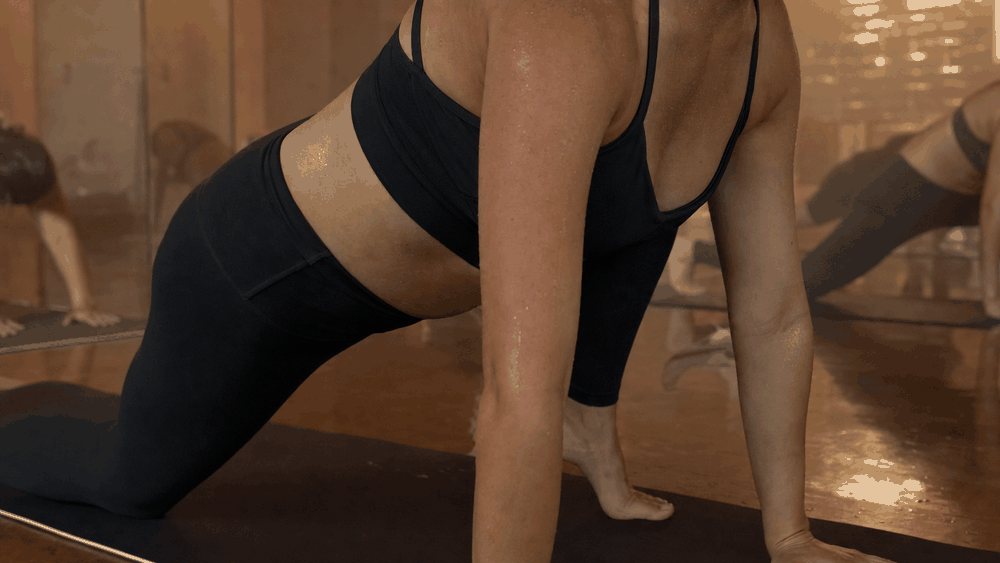
What actually happens inside a sports bra at 40°C?
At room temperature, a well-designed sports bra manages three things: breast displacement, pressure distribution, and skin friction. The underband carries the majority of the total support load. As Joanna Wakefield-Scurr, who leads the University of Portsmouth’s Breast Health Research Group, puts it: the underband is “the foundation of any bra.” Straps handle micro-adjustment. This system works because dry synthetic fabric grips dry skin with a predictable coefficient of friction.
At 40°C, that system breaks down in a specific order.
First, perspiration saturates the fabric-to-skin interface. Sweat acts as a boundary lubricant between the synthetic knit and your skin, and the static friction that anchors the underband drops sharply. Second, elastane filaments inside the underband begin losing recovery tension. Industry wear-testing suggests that after roughly 15 cold-wash cycles, the tension in a typical sports bra underband drops by about 20 percent. In a heated studio, where a single 60-minute class can drench the bra completely, this degradation accelerates. Third, the breast tissue itself behaves differently. Research published in Experimental Physiology (Blount et al., 2024-2025) found that breast skin stiffness and thermal sensitivity vary by region: the upper breast bears the highest mechanical strain, while sweat gland density decreases as breast size increases, meaning larger-breasted practitioners sweat less efficiently across the breast surface.
Put simply, at 40°C, the bra is wetter, stretchier, and gripping less, at the exact moment the wearer needs it to stay put through inversions and rapid transitions.
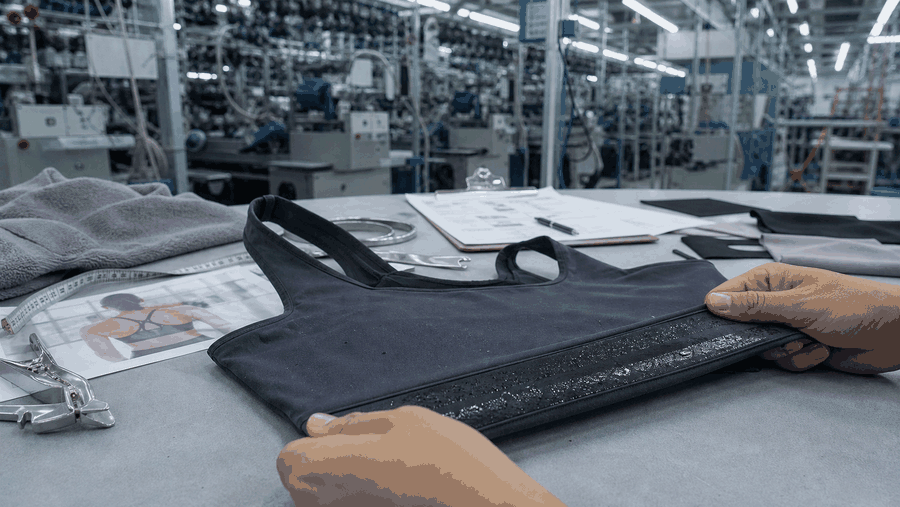
Why does your underband lose grip when it gets wet?
Consumers have a name for what happens next. They call it the “inchworm effect”: the band creeps up the ribcage millimeter by millimeter with every forward fold and downward dog. Sweat eliminates friction, and a relaxed band migrates to the path of least resistance: upward.
This is not just a consumer complaint. It is a measurable physical phenomenon. Researchers at the University of Delaware used Kikuhime pressure sensors on a standardized mannequin to measure underband compression in dry versus wet conditions. The mean pressure dropped from 8.47 mmHg to 6.94 mmHg after just 2.5 grams of water was introduced between the breasts. That is a statistically significant decline of 1.53 mmHg, and it happens almost immediately when sweat enters the system.
One counterintuitive finding from the same study: fabrics with tighter stitch lengths and higher yarn tension showed a larger pressure drop between dry and wet states. In other words, the densest, tightest knit, the one that feels most supportive when you try it on dry, may actually lose more grip once it is soaked. For hot yoga, a bra that tests perfectly in a fitting room may be the worst performer after 20 minutes in a heated studio.
The practical takeaway for brands: an underband should not rely on elastic tension alone. Silicone grip strips, wider band construction (5 to 7 centimeters, compared to the standard 3 to 4), and perforated silicone dot patterns that maintain friction when wet are all design strategies that address the lubricant problem at the material level, giving the underband grip that elastic tension alone cannot provide when wet.
Which actually does the work: straps or underband?
Many brands invest their design attention in the back: crisscross straps, keyhole cutouts, racerback geometries. These are visually distinctive and photograph well. But from a biomechanical standpoint, shoulder straps are a secondary support system.
Joanna Wakefield-Scurr, who leads the Breast Health Research Group at the University of Portsmouth, puts it directly in a Runner’s World interview: “Underband is the foundation of any bra. Always check the amount of stretch in the underband first of all. The one that has the least stretch is going to provide you with the most support.”
Straps matter, but they matter differently in a hot yoga context. A racerback design, while popular for its stay-put geometry, covers one of the body’s primary heat and sweat zones. LaJean Lawson, a sports bra consultant with a PhD in exercise science, notes that racerbacks constructed from solid rather than mesh fabrics trap heat and moisture against the upper spine, which is exactly where hot yoga practitioners need ventilation. A poorly designed crisscross strap can also sit directly against the bottom of the shoulder blades, creating a chafing hotspot when the skin is already sensitized by heat and salt.
For heated practice, the strap geometry question is really a question of tradeoffs: a racerback that stays put but traps heat versus an H-back that breathes but may slip. Neither is universally correct. What matters is that brands make this decision consciously rather than defaulting to the silhouette that photographs best.
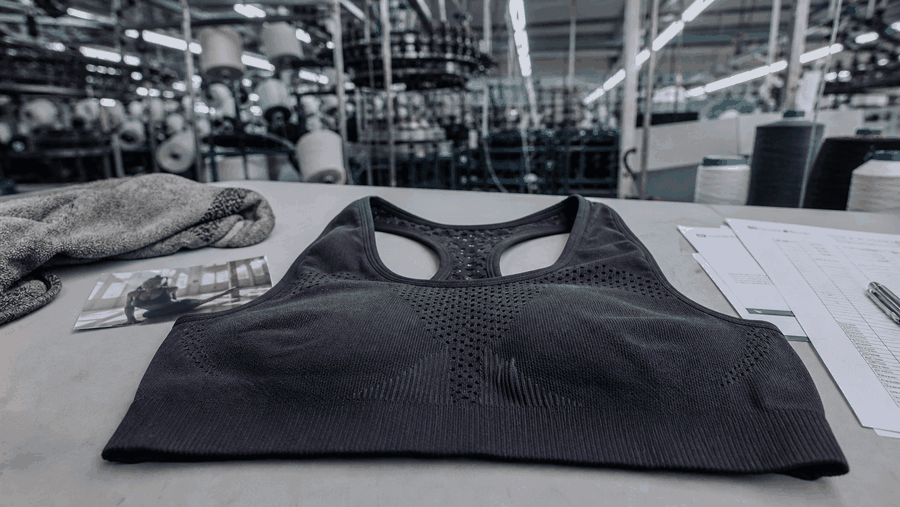
Why knit structure matters more than fiber content for heat management
This is where the conversation usually goes wrong. Brands ask their manufacturer: “What is your best moisture-wicking fabric?” The manufacturer sends a polyester-spandex blend with a wicking finish. The brand approves the swatch. And the bra underperforms in a heated studio.
The problem is that fiber content tells you what the yarn is made of. It does not tell you how the fabric moves sweat, how much air it traps, or how it behaves when saturated. A 2025 study published in the Indian Journal of Fibre & Textile Research by researchers from Visva-Bharati University and Birla Cellulose put this to the test. Their conclusion: knit structure significantly influences both wicking behavior and heat flux, or Qmax, the measure of how cool a fabric feels on contact. Fabrics with greater air entrapment, a function of stitch density and construction rather than fiber type, showed lower Qmax values, meaning less cooling sensation. When a hydrophobic finish was applied to the back layer and a hydrophilic face was used on the outer layer, the directional moisture gradient pulled sweat from the skin side to the exterior. That is a structural design decision, not a fiber choice.
What does this mean for a hot yoga bra? A seamless circular knit on a Santoni machine can vary stitch density across zones: tighter in the underband and cup area for compression and support, more open in the back panel for ventilation. This zoning happens within a single continuous tube of fabric. No seams. No separate panels stitched together. The structure is the performance.
Compare this to a cut-and-sew bra, where each panel is cut from flat fabric and seamed together. Cut-and-sew offers unmatched flexibility for complex pattern lines and multi-fabric compositions, which matters for bras with intricate design lines or multiple material types. But every seam is a potential friction point, and at 40°C, with salt-laden sweat, a raised seam against wet skin acts closer to sandpaper than fabric. This is why the choice between seamless and cut-and-sew is not a question of which is “better.” It is a question of which tradeoffs your specific product can accept. For a hot yoga bra where moisture saturation is guaranteed, minimizing seam contact in high-friction zones (underband, armhole, inner strap edge) is worth the design constraint.
What to ask your manufacturer about hot yoga bra design
You do not need to become a textile engineer to spec a bra that performs at 40°C. You need to ask the right questions when you sit down with your manufacturing partner. Here are the five that matter most.
How is the underband gripping when wet? Ask whether the underband uses silicone grip strips, and if so, whether the silicone is applied as a continuous strip or a perforated dot pattern. Perforated silicone maintains friction while allowing some ventilation. Ask what the underband width is. A band narrower than 4 centimeters is relying mostly on elastic tension, which is the first thing to degrade when saturated.
Can the knit structure vary density across zones? If the bra is seamless, ask whether the knitting program supports zone-specific density control: higher density in the cup and underband for support, lower density in the back panel for breathability. If the bra is cut-and-sew, ask which panels use which knit structures, and whether the stitching layout avoids concentrated seam intersections in the underband and armhole areas.
What is the seam strategy for friction hotspots? Ask how the manufacturer handles the three highest-risk chafe zones: the underband interior, the armhole edge, and the inner strap surface. Ultrasonic bonding can create a flat, seamless finish on synthetic fabric blends, eliminating the raised profile of a traditional overlock or flatlock stitch. But ultrasonic bonding works only on synthetic fiber compositions. If the fabric includes natural fibers, a flatlock seam with a low-profile stitch is the next best option.
What happens after 50 washes? Industry wear-testing suggests elastane loses roughly 15 to 20 percent of its recovery tension after approximately 50 wash cycles. Ask your manufacturer for wash test data: what is the elastic recovery rate after 30 and 50 cycles? A bra that tests well fresh out of the package but degrades by week six becomes a return rate problem. The care instructions matter too: cold water washing and air drying can extend underband integrity to four months or more, while hot water and fabric softener can collapse it within six weeks.
Are we testing in conditions that match the end use? A standard fit test in an air-conditioned showroom will not tell you what happens in a 40°C studio. Ask whether your manufacturer has the capability to evaluate fit and retention under heated, humidified conditions, or whether you need to build that step into your own sampling process.
Three decisions that make a hot yoga bra work
If we step back from the technical details, the engineering challenge simplifies to three decisions.
First, structure over composition. Fiber content labels tell part of the story. Knit density, stitch geometry, and zone construction tell the rest, and in a saturated environment, they tell the more important part.
Second, underband over straps. A beautifully designed back loses its value if the band creeps up the ribcage after 10 minutes. Invest design attention in how the bra anchors, not just how it looks from behind.
Third, wet-state performance over dry-state hand feel. The bra that feels tightest and most supportive in a fitting room may be the one that loses the most tension once sweat enters the picture. Test in conditions that match the studio, not the showroom.
None of these decisions require exotic materials or unproven technologies. They require manufacturing partners who can execute zone-specific knitting, who understand the difference between a seam that looks clean and a seam that stays flat when wet, and who can talk about knit structure with the same fluency they use for fiber composition.
At Ziyang, our Santoni seamless knitting lines allow zone-level density control within a single garment, from compression-grade fabric under the bust to open ventilation across the back. When the design calls for complex panel construction, our cut-and-sew line handles multi-fabric compositions, and we use bonding on synthetic blends to eliminate raised seams in friction-sensitive areas. Since 2013, we have worked with over 90 brands across more than 70 countries to bridge the gap between boutique design concepts and industrial-scale production.
Thinking about your next yoga bra collection? Whether you are targeting the growing hot yoga market or refining an existing performance line, the conversation starts with knit structure, not fiber tags. We would be happy to walk through what zone engineering can do for your product.
Post time: Jul-11-2026
